

How To Clean Monster Clay Out Of A Deep Mold
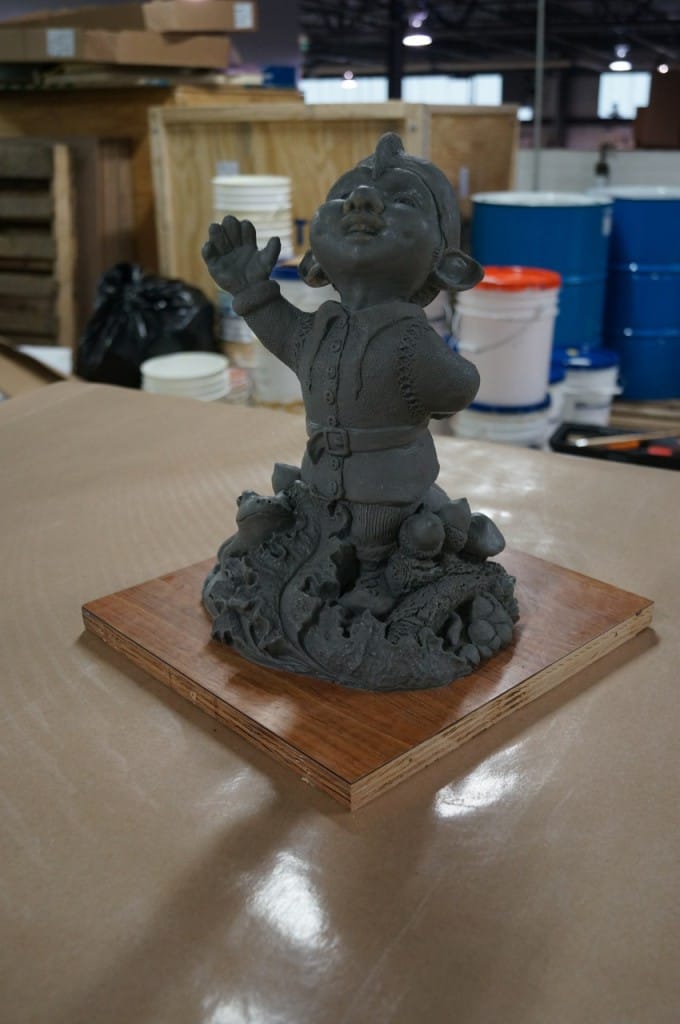
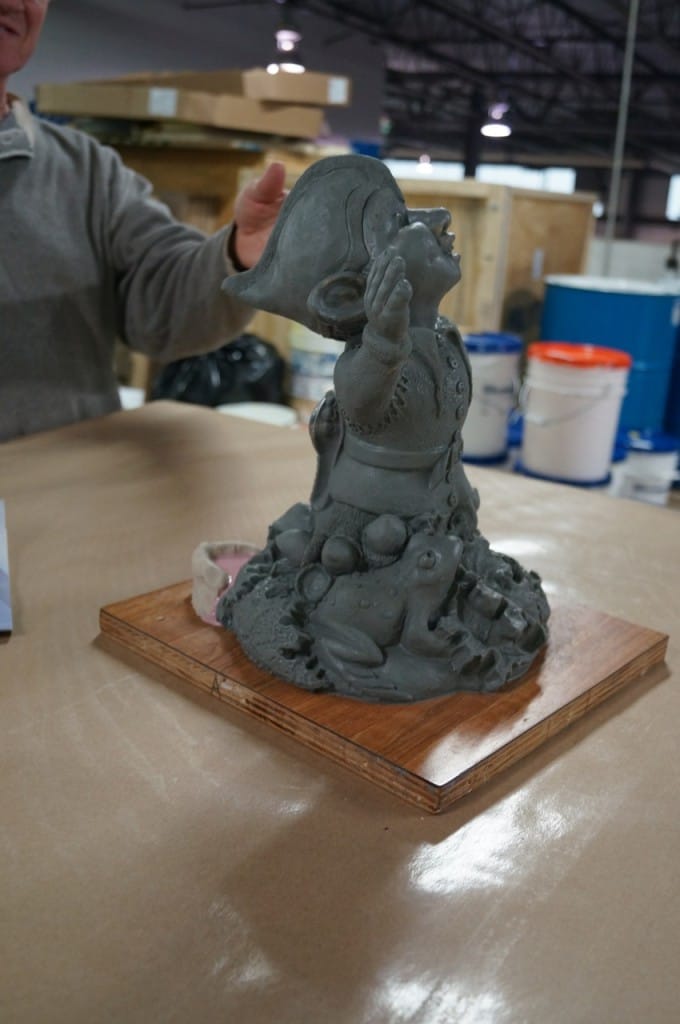
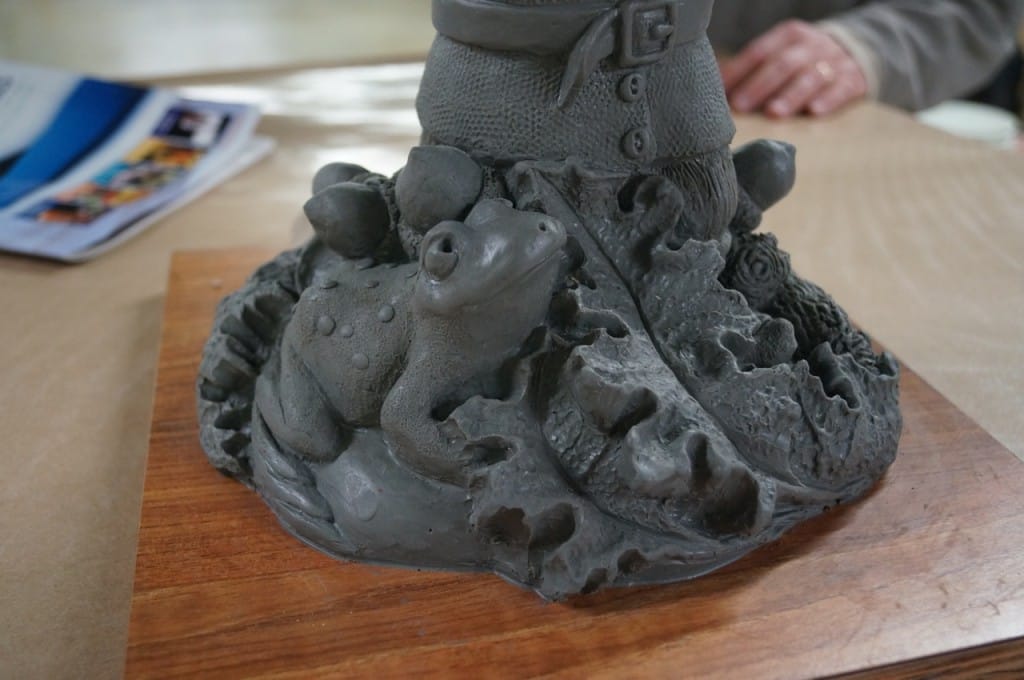
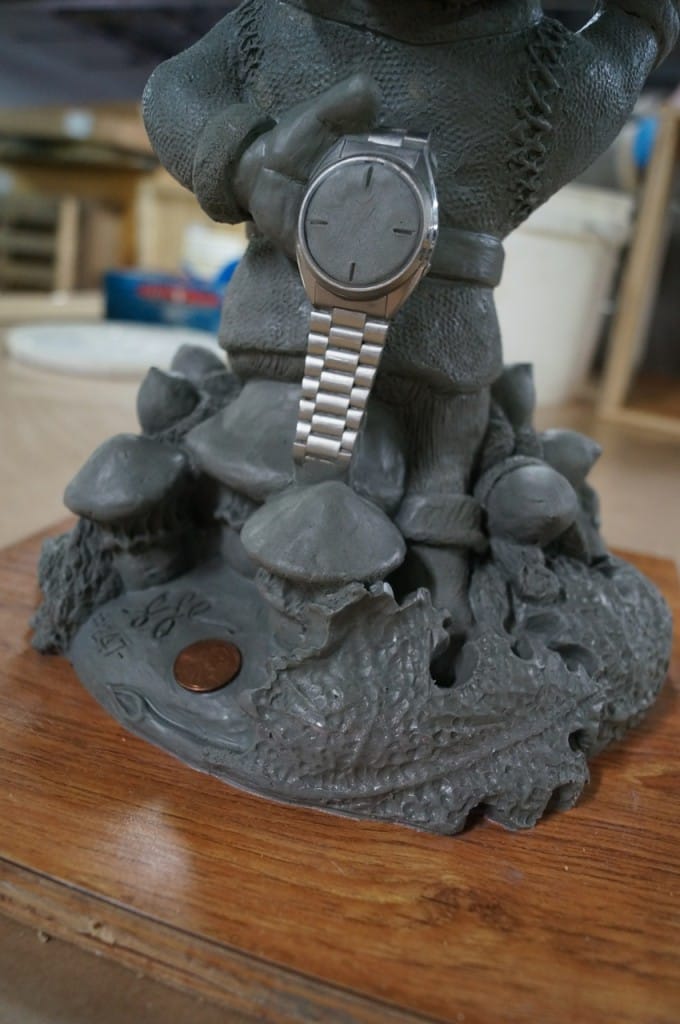
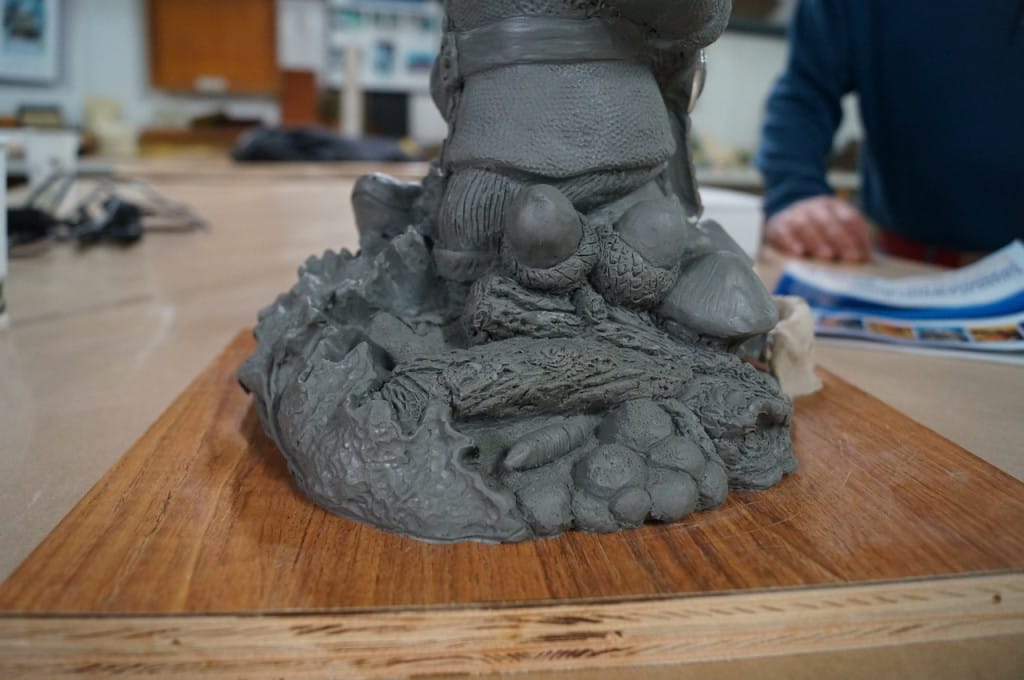
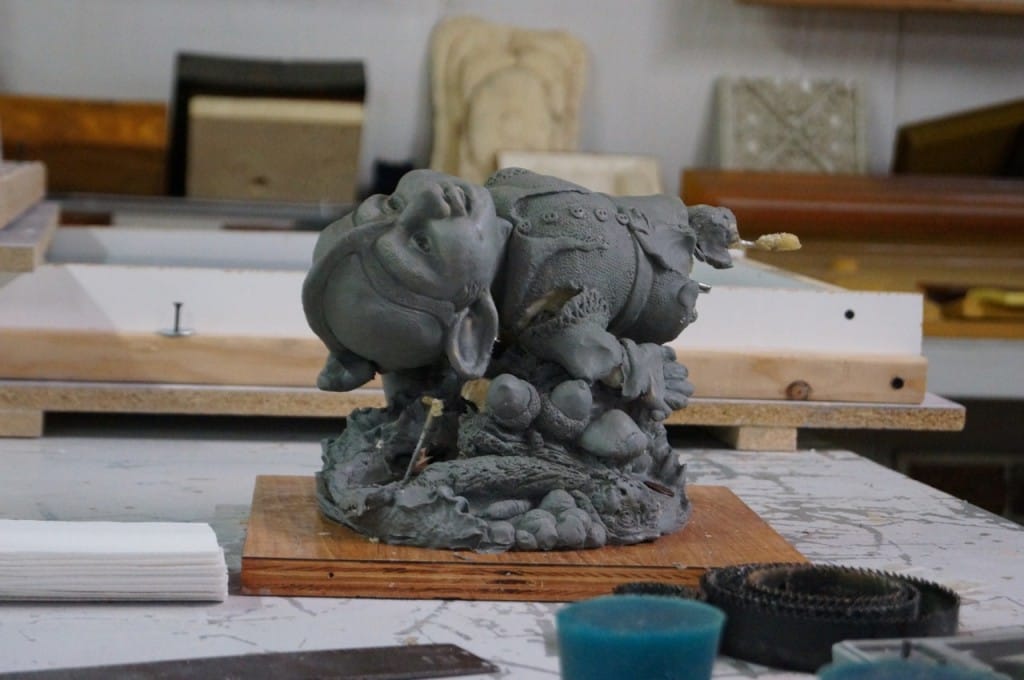
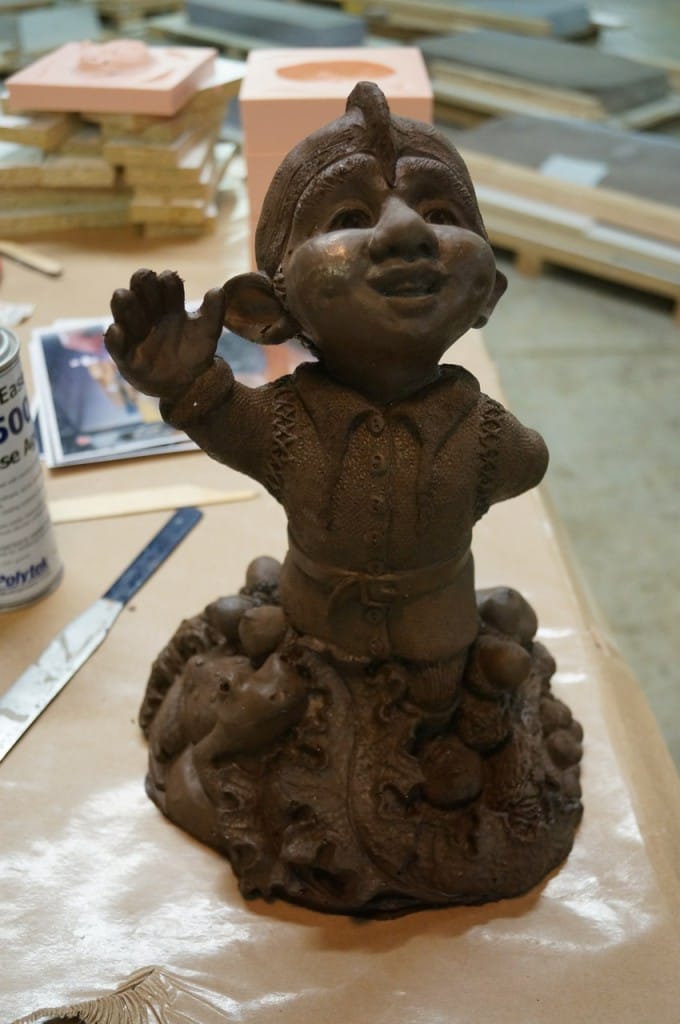
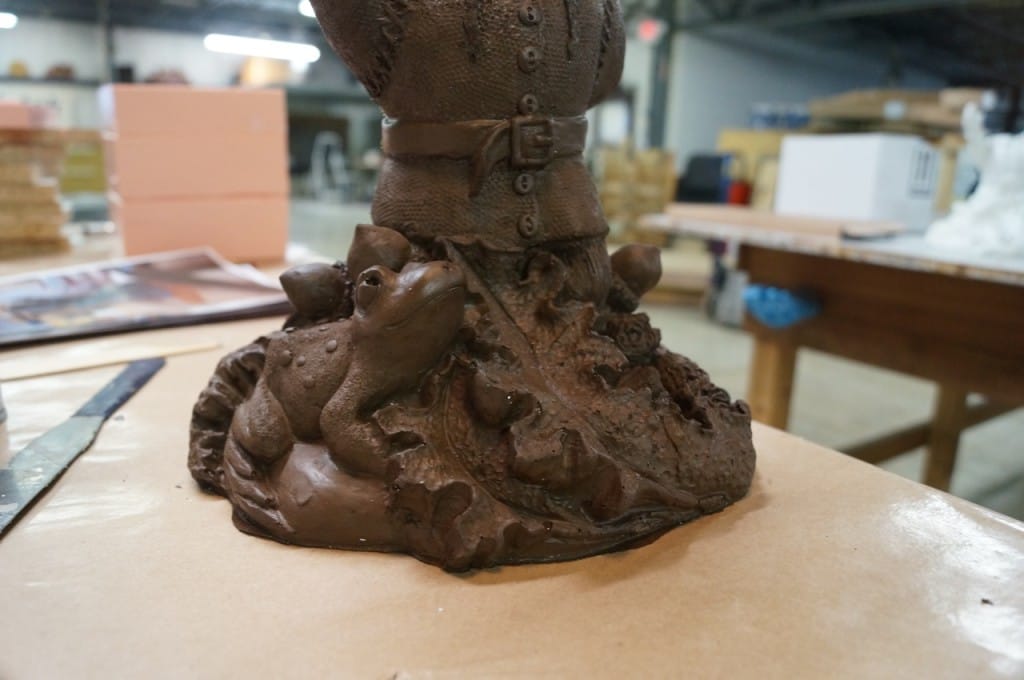
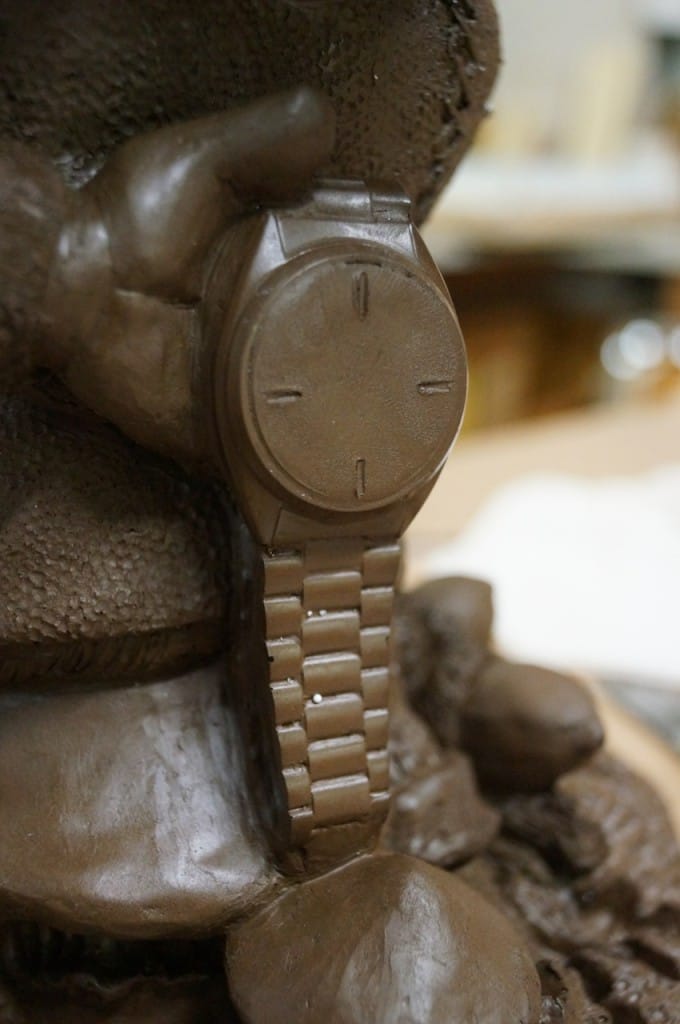
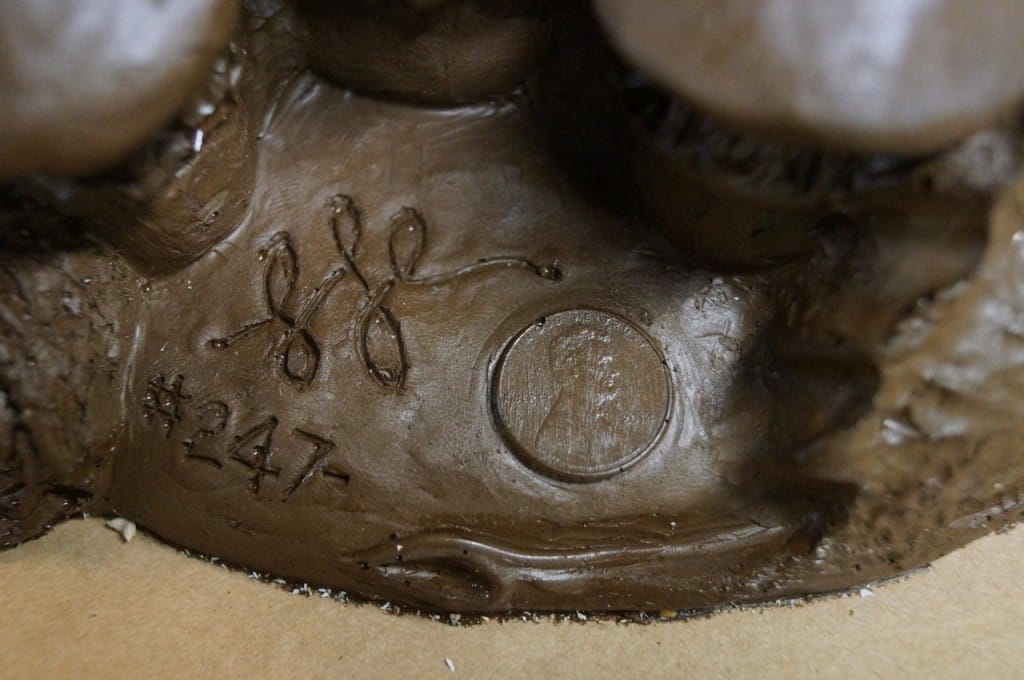
John Cannon of The Whimsical Gardens brought his dirt sculpture to our facility to make a mold of the figure and then reproduce information technology in plastic on a rotational casting car. The detailed sculpture is pictured below from different angles.
This article details the steps that nosotros took throughout the mold making and casting process:
Step i: Select a Mold Making Method & Mold Rubber
Pace 2: Construct Mold Box & Fix Sculpture
Pace 3: Measure, Mix & Cascade Silicone Mold Safe
Step 4: Demold
Step 5: Cut the Mold
Step 6: Rotational Casting
Step one: Select a Mold Making Method & Mold Condom
Mold Making Method
For this sculpture, we select the "poured block mold" method.
Hither are the reasons that we are eliminating other methods:
Brush-on Mold: We are concerned that air bubbling may form in the intricate details on the base of the sculpture. Also, brush-on molds tend to have thick and thin spots – sparse spots stop up existence weak points in the mold.
Poured Blanket Mold: One of the steps in the poured coating mold procedure is to form a layer of dirt on top of the original model (review a poured coating mold tutorial here). This stride would most likely deform the clay original.
Based on the shape of the sculpture, nosotros as well know that the mold volition require a cutting in order to remove the original sculpture and subsequent castings.
Mold Rubber
For this particular project, nosotros too know that we desire to use a silicone mold rubber because it does not crave release agent when casting polyurethane resin. Release agent tin be difficult to apply in intricate areas and it may be hard to remove from the casting. Residuum release agent can prevent paint from sticking to castings.
Platinum-Cured vs. Tin-Cured Silicone Rubbers
Polytek silicone falls into ii full general categories: platinum-cured and tin-cured. Basic comparisons betwixt the 2 options are in the tabular array below:
| Rubber Type | Advantages | Disadvantages | Casting Materials | Methods |
| Platinum-Cured Silicone Mold Rubbers | No shrink on cure, cured rubber has long storage life | Liquid safe can suffer from cure inhibition by some materials (east.g., sulfur clay, tin silicones, Bondo, some 3D-printed plastics, latex condom). | Near materials, particularly resins, foams and some low-melt metals. | Pour, Brush, Spray. |
| Tin can-Cured Silicone Mold Rubbers | No cure inhibition, slightly less expensive than platinum-cured systems | Shrinks on cure (~1%), shorter library life (2-5 yrs.) than platinum-cured systems. | Most materials, specially resins, foams and some depression-melt metals. Tin can inhibit polyurethane rubber, platinum-cured silicone, and 14-Series Poly-Optic Resin castings. | Pour, Castor, Spray. |
Platinum-cured silicone rubbers have advantages compared to tin-cured silicone rubbers (eastward.g., no shrink on cure, longer library life), but can suffer from cure inhibition when exposed to certain materials. Sulfur, for case, is a known inhibitor and is present in some modeling clays.
We are unsure if John's sculpture contains sulfur, so nosotros perform a small examination cure.
To do the test, we mix and pour a fast-setting platinum silicone rubber (PlatSil® 71-10) into a dirt containment area against a small-scale department on the backside of the sculpture.
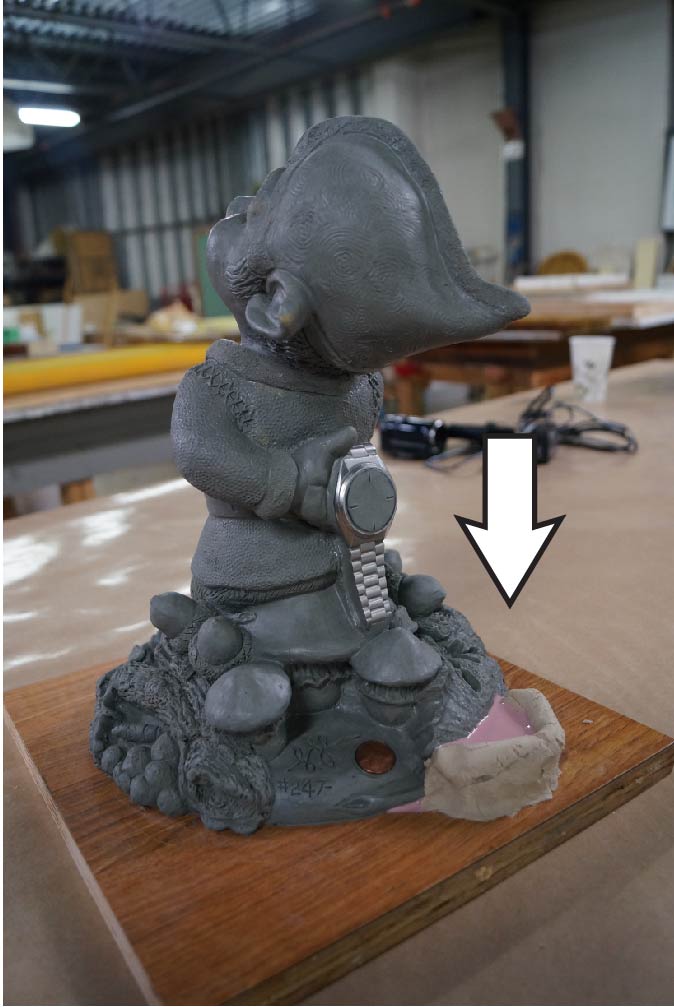
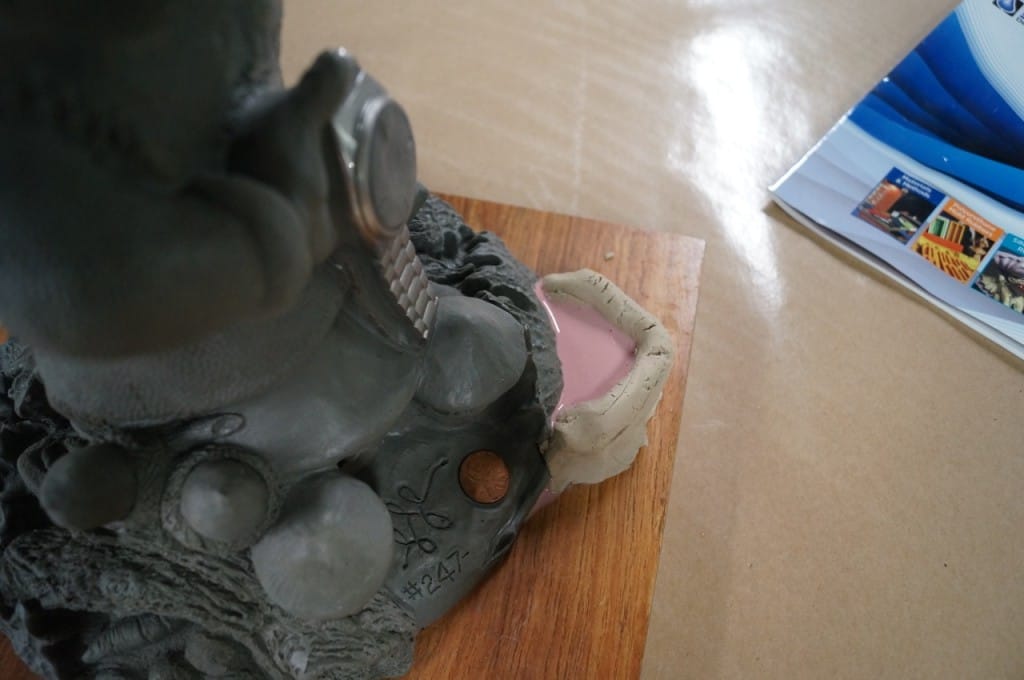
Later xxx minutes, nosotros remove the silicone rubber to determine if information technology has cured properly. We find that the rubber that touched the sculpture remained gummy while the sides of the prophylactic exposed to air and clay cured properly. This indicates that there is a contaminate inside or on the clay that would forestall whatsoever platinum-cured silicone rubber from curing properly.
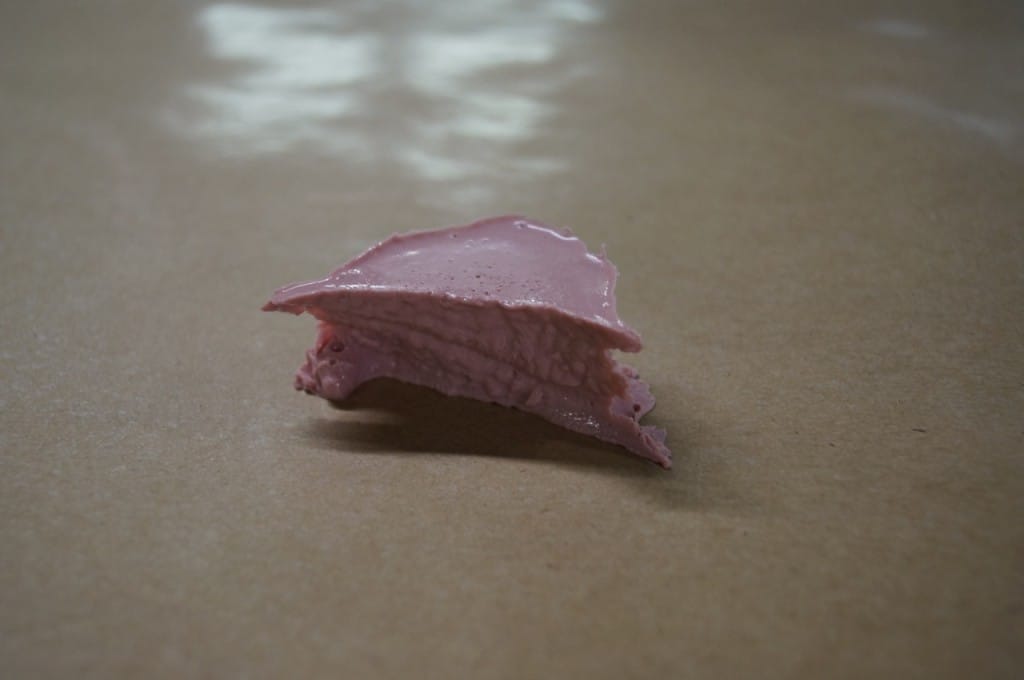
Based on these findings, we select a tin-cured silicone rubber as the mold material:TinSil® fourscore-15 Silicone Prophylactic. Nosotros cull a soft silicone (Shore A15) due to the deep undercuts on the sculpture. A harder rubber could be more difficult to remove without damage.
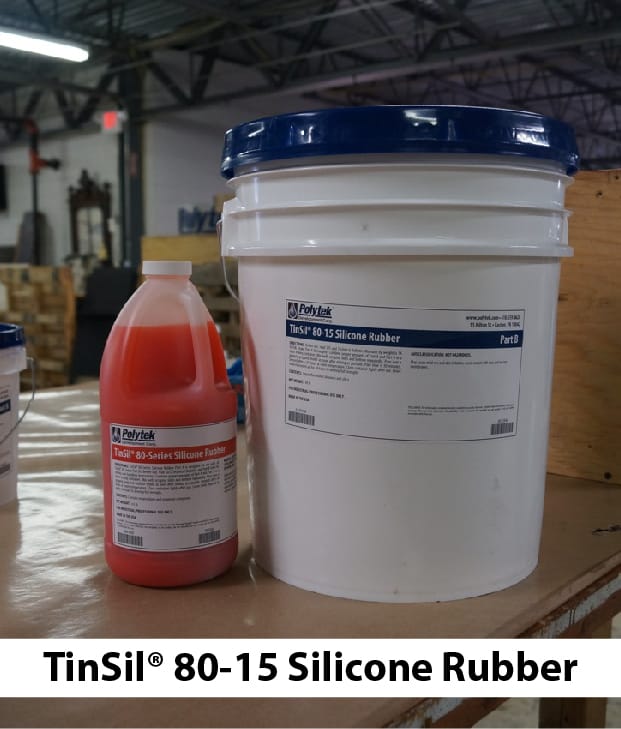
TinSil 80-15 Silicone Condom: Specifications Hardness: Shore A15 Mix Ratio: 1A:10B Pour Time: 30 Minutes Mixed Viscosity: 12,000 cP Demold Fourth dimension: 24 Hours Cured Color: Peach Specific Book: 25.iii in³/lb
Step two: Construct Mold Box & Prepare Sculpture
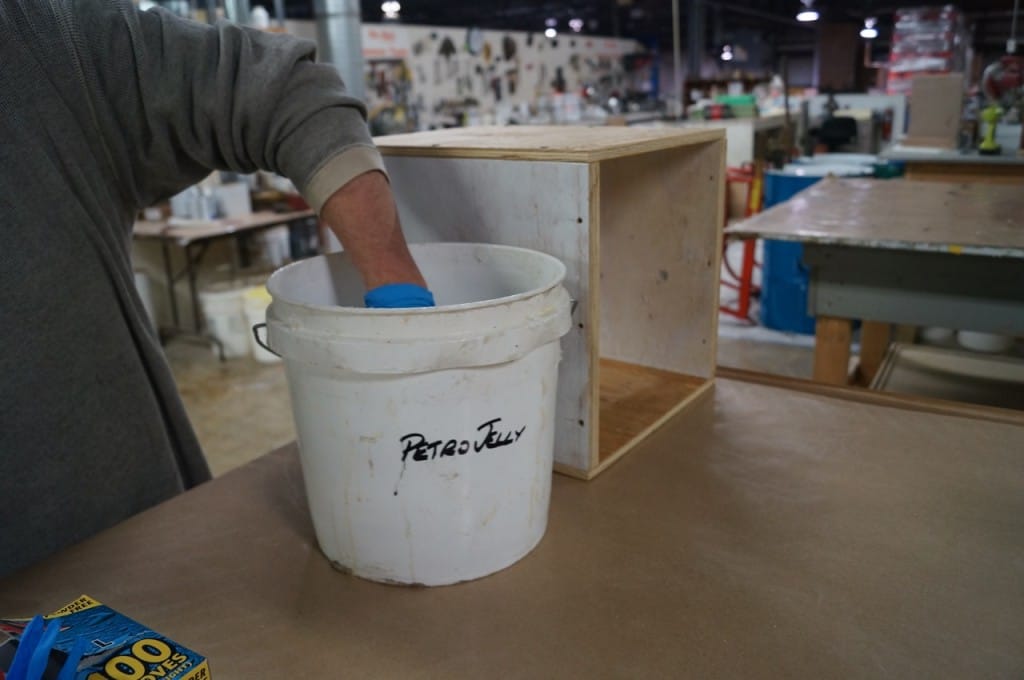
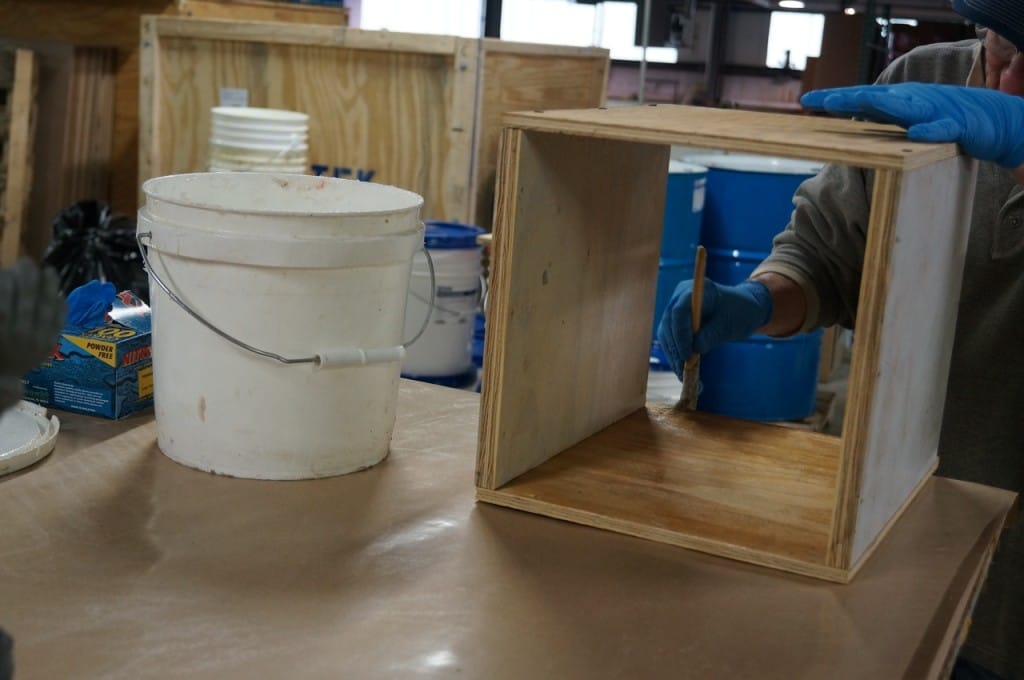
To brainstorm, a plywood mold box is constructed at the proper dimensions (i.e., at to the lowest degree 1″ beyond the sculpture in all directions) and then sealed with petroleum jelly.
Note:It is a good thought to taper the inside of the mold box then the mold tin can be removed more easily when the mold box is turned upside-down.
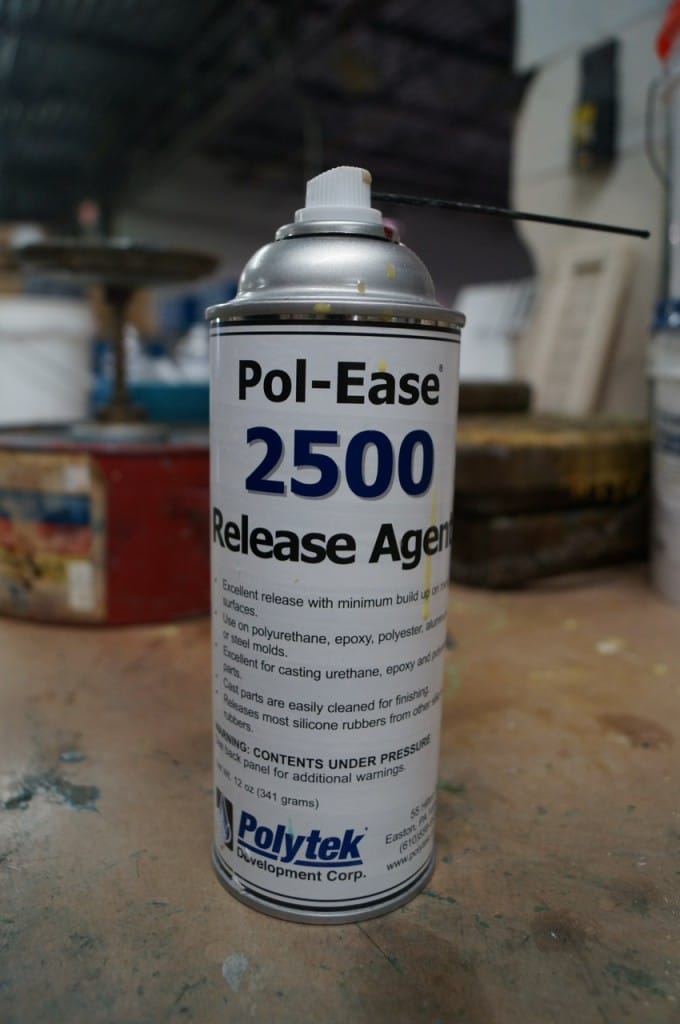
Pol-Ease® 2500 Release Amanuensis is then applied to the clay sculpture.
Notation: Employ Pol-Ease® 2300 if making a polyurethane safe mold.
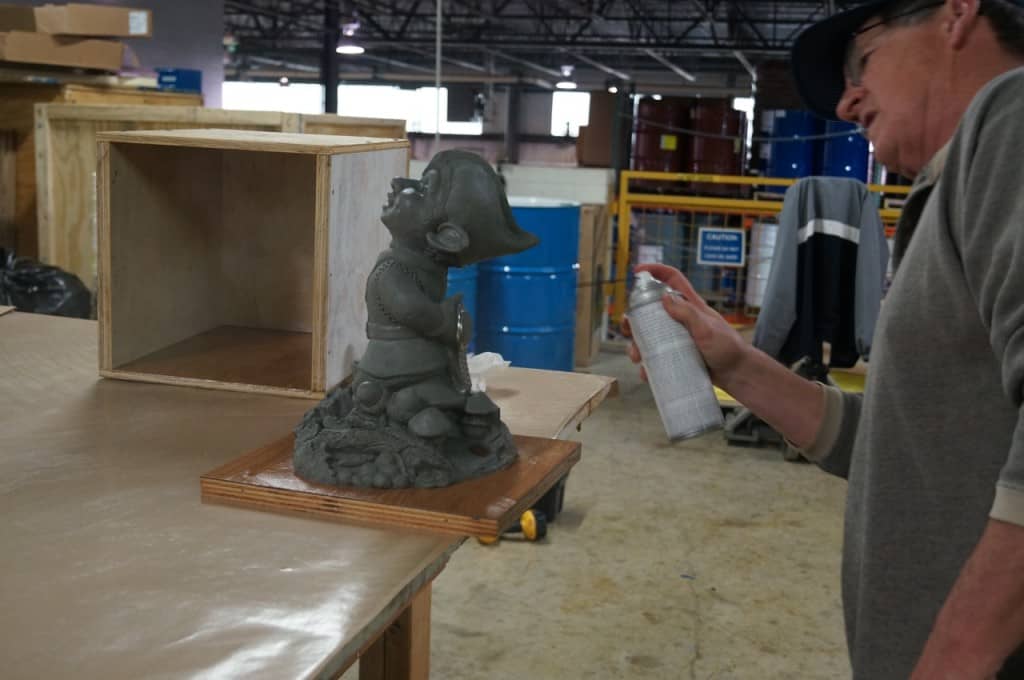
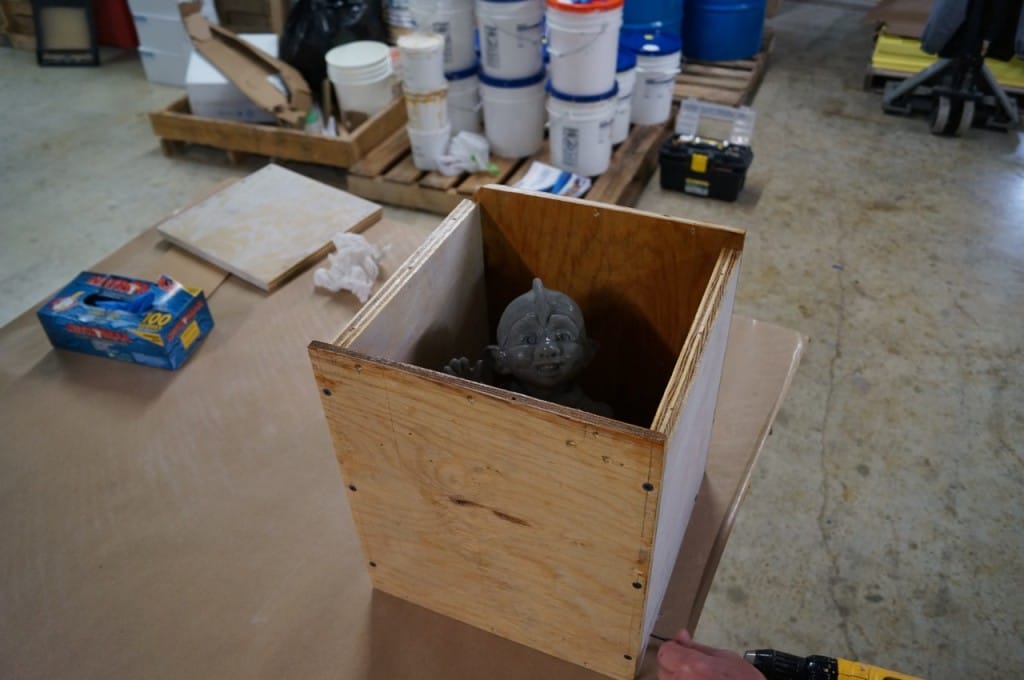
The mold box is placed effectually the prepared sculpture to verify that the dimensions are suitable.
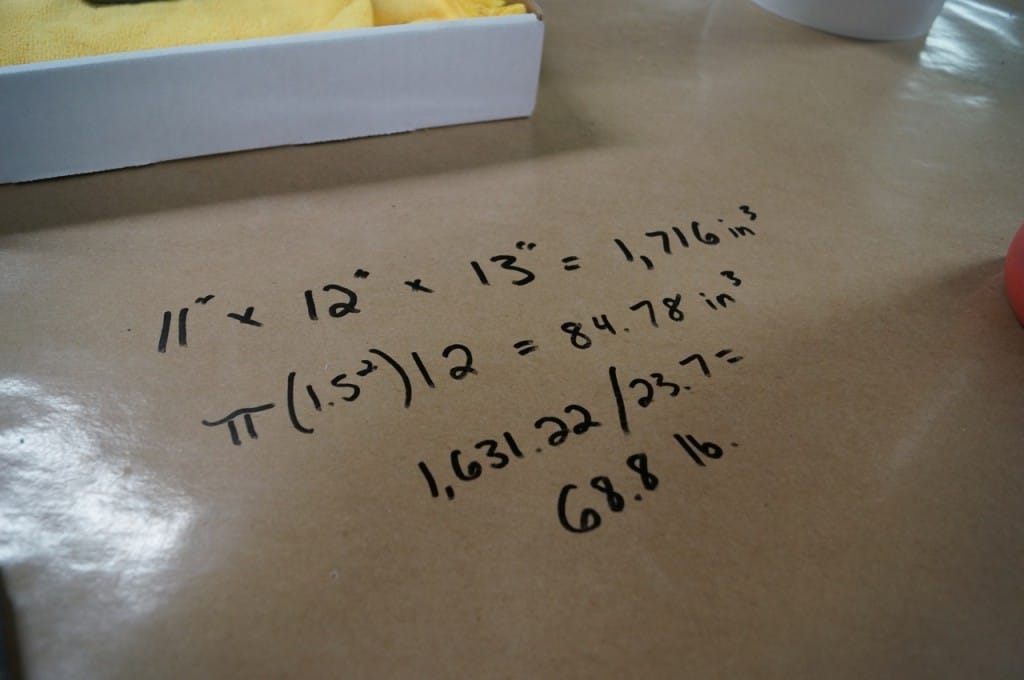
We guess the amount of prophylactic needed for the mold with the following adding:
Volume of Mold Box = ~1,716 in3
Volume of Sculpture = ~84.78 in3
Volume of Mold Box – Volume of Sculpture: i,716in3– 84.78 in3 = 1,631.22 in3
ane,631.22 iniii÷ 23.7 in3/lb (specific volume of TinSil eighty-15) = 68.viii lb of TinSil 80-fifteen Silicone Rubber
68.8 lb is a large amount of prophylactic and we realize that there is opportunity to reduce that corporeality by adding corner inserts and other block-outs.
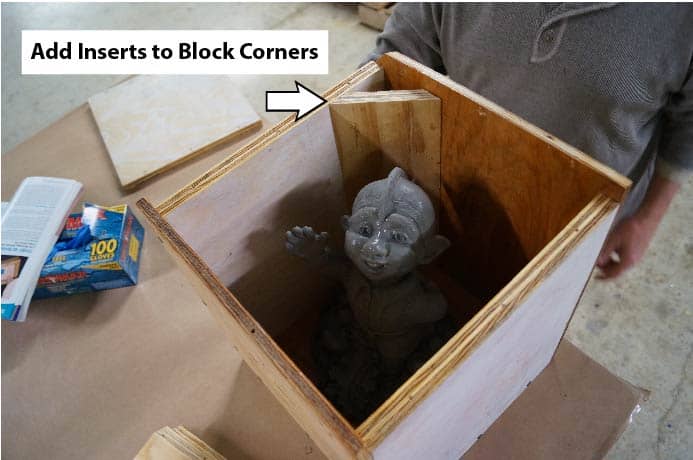
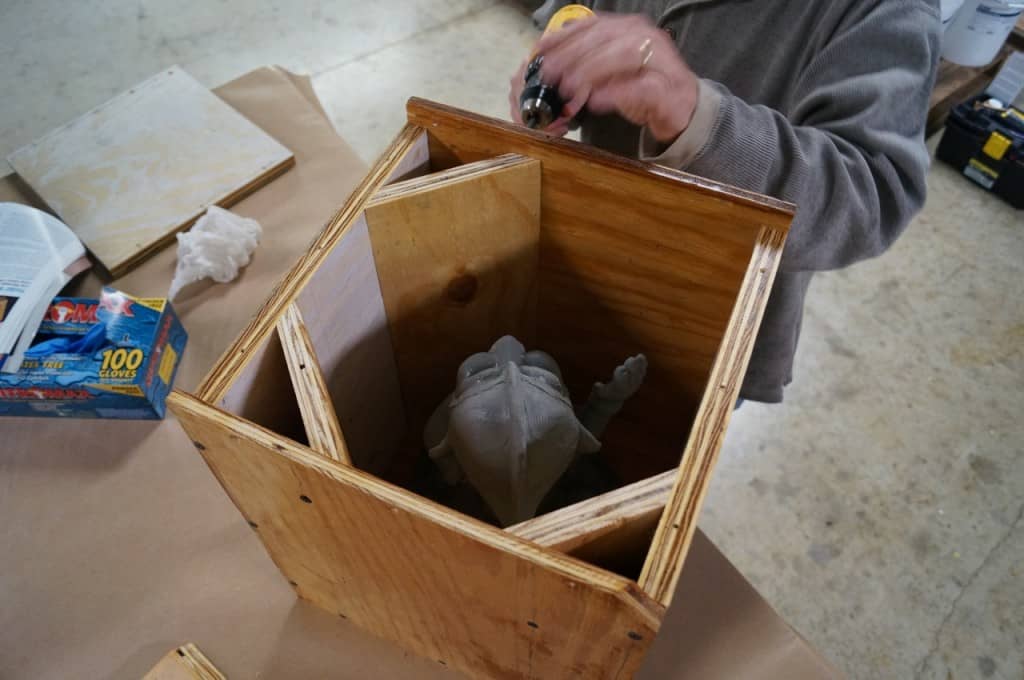
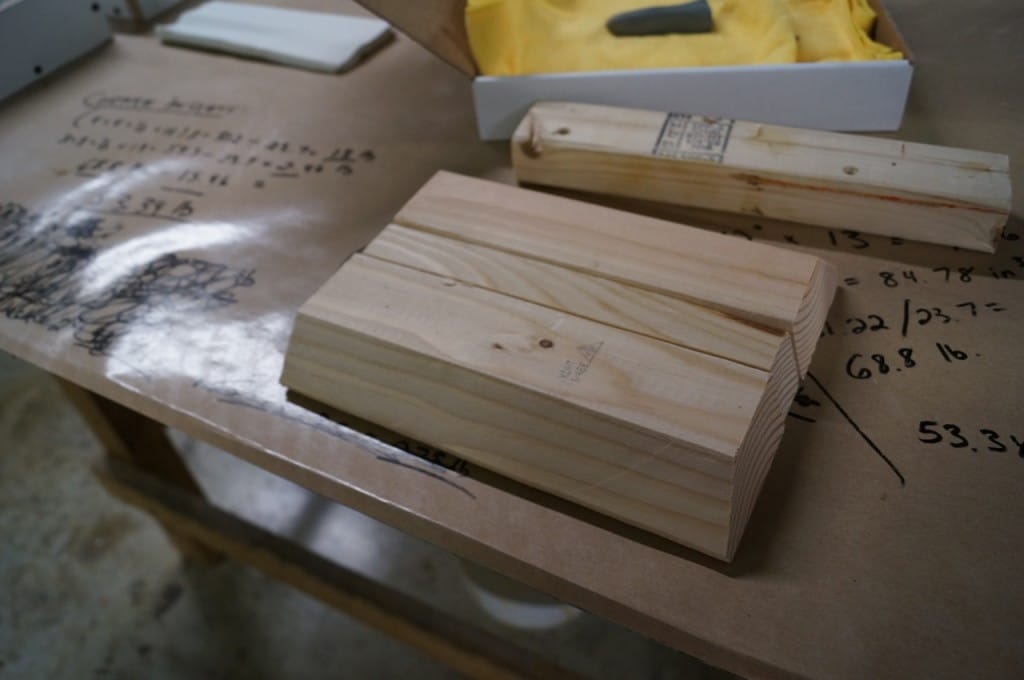
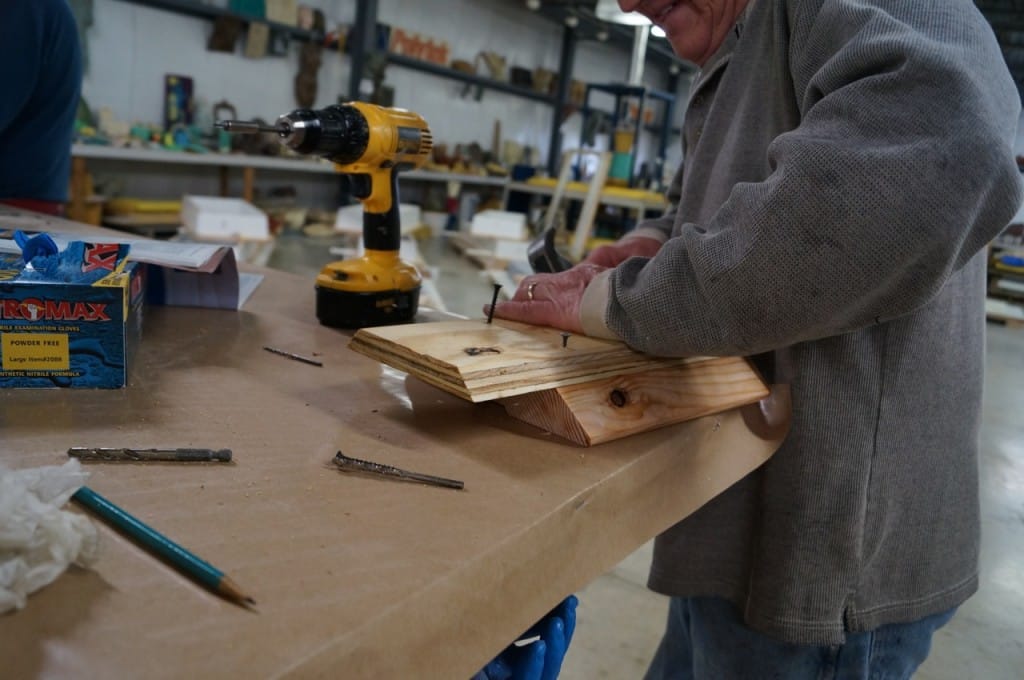
We add a number of block-outs, merely even so maintain at least a one″ space between the sculpture and mold box walls/block-outs.
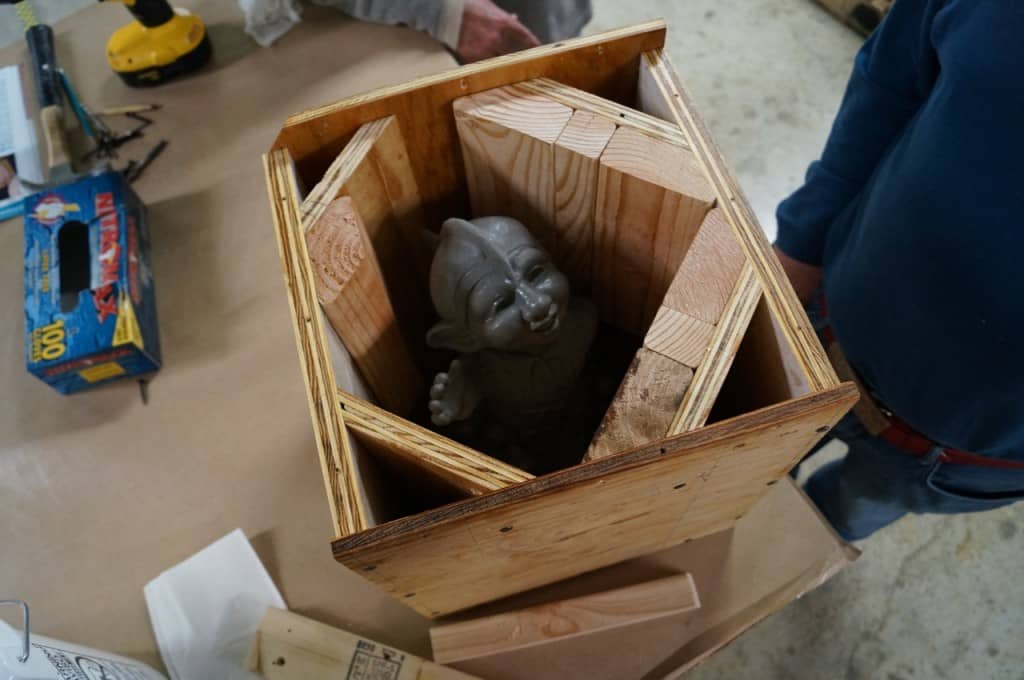
Once all of the block-outs are secured, the mold box is removed to seal the new plywood additions with petroleum jelly and caulk all edges with warmed plasticine clay. Caulking the edges helps to prevent leaking when liquid silicone is poured into the mold box later.
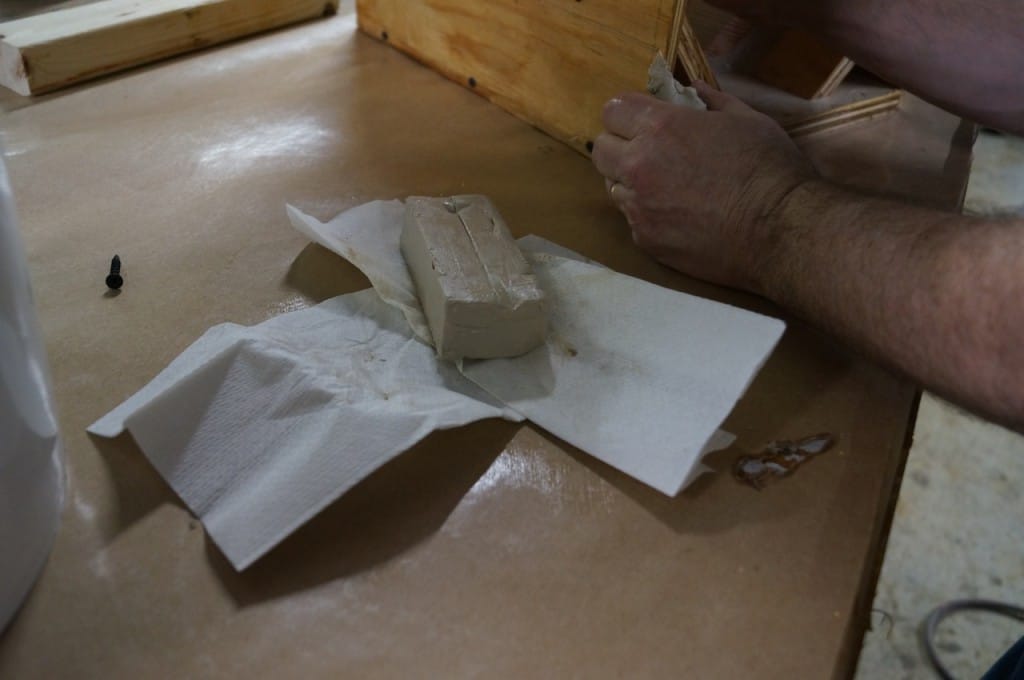
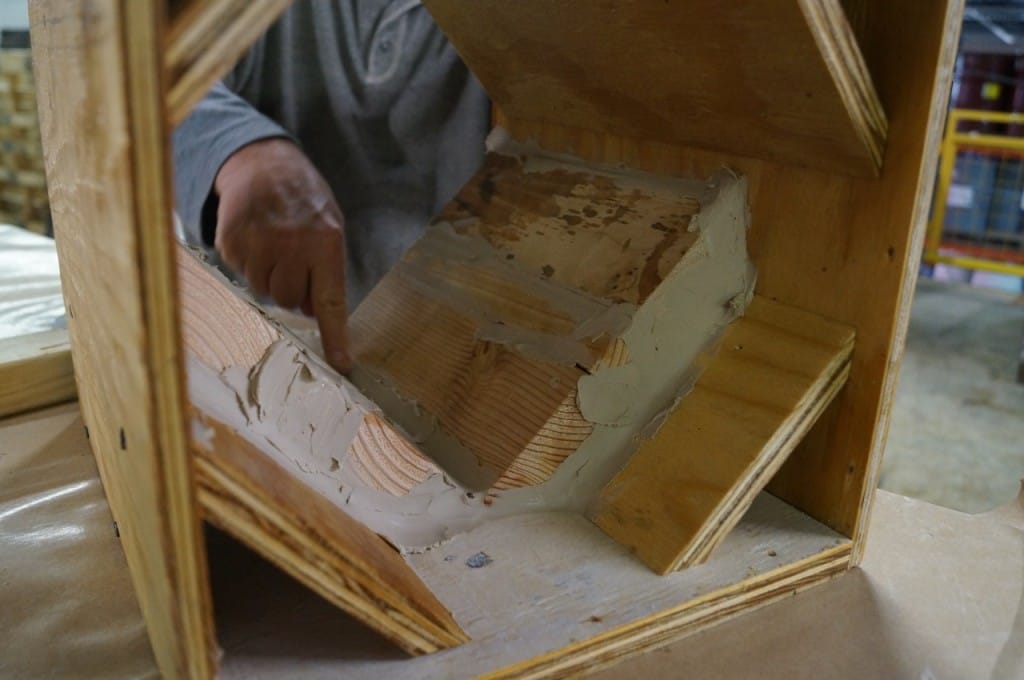
The sculpture is placed dorsum into the mold box and then the mold box is secured with screws.
Stride 3: Measure, Mix & Pour Silicone Mold Prophylactic
Based on the new dimensions of the mold box, we determine that approximately xl lb of TinSil lxxx-fifteen Silicone Prophylactic is needed to make the mold.
As mentioned previously, TinSil eighty-15 has a mix ratio of 1A:10B. The components are measured by weight and and then mixed thoroughly.
NOTE: Practise not attempt to measure products with 1A:10B mix ratios by book – always measure past weight.
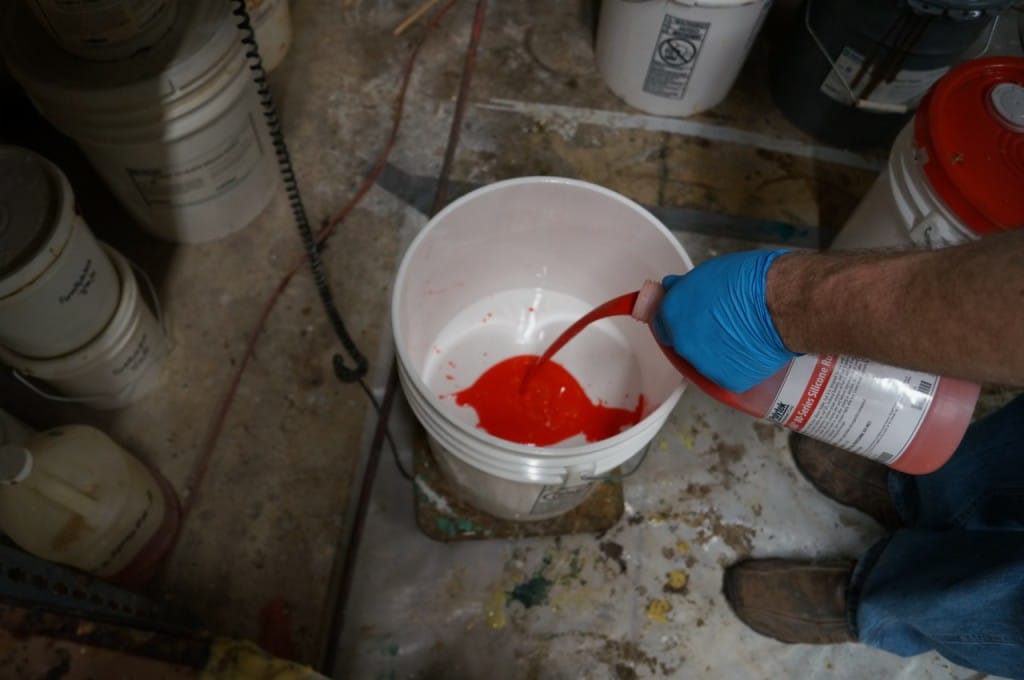
Because of the quantity of rubber needed for this projection, we mix two separate batches using a turbo mixer.
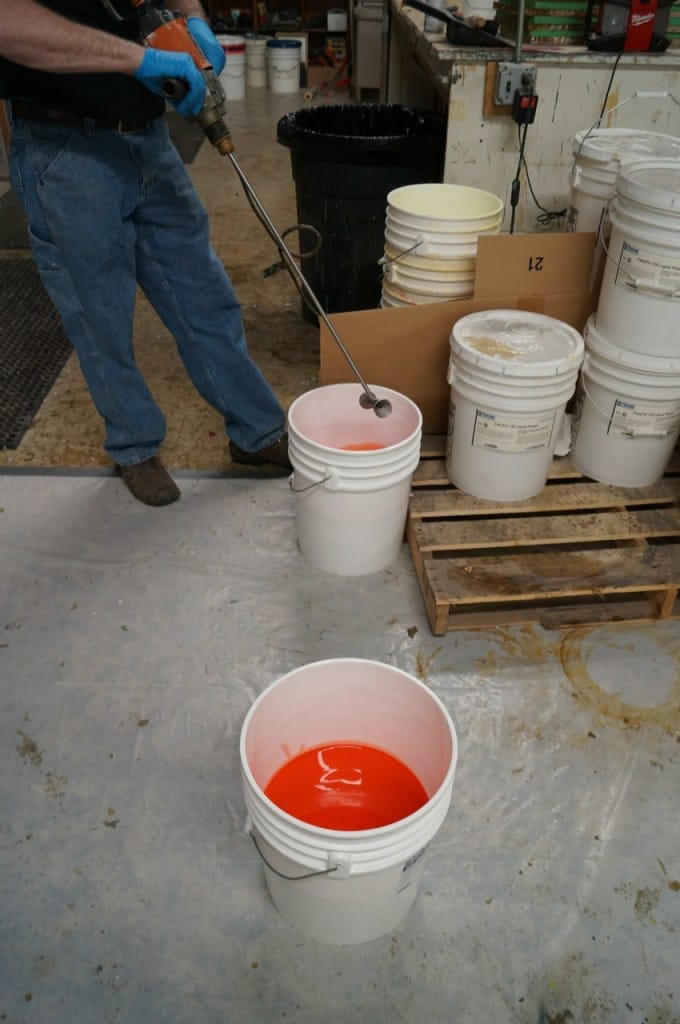
The rubber is mixed until a uniform color is reached.
Note: Avoid striking the sides of the mixing pail with the turbo mixer as this can innovate air into the mixture.
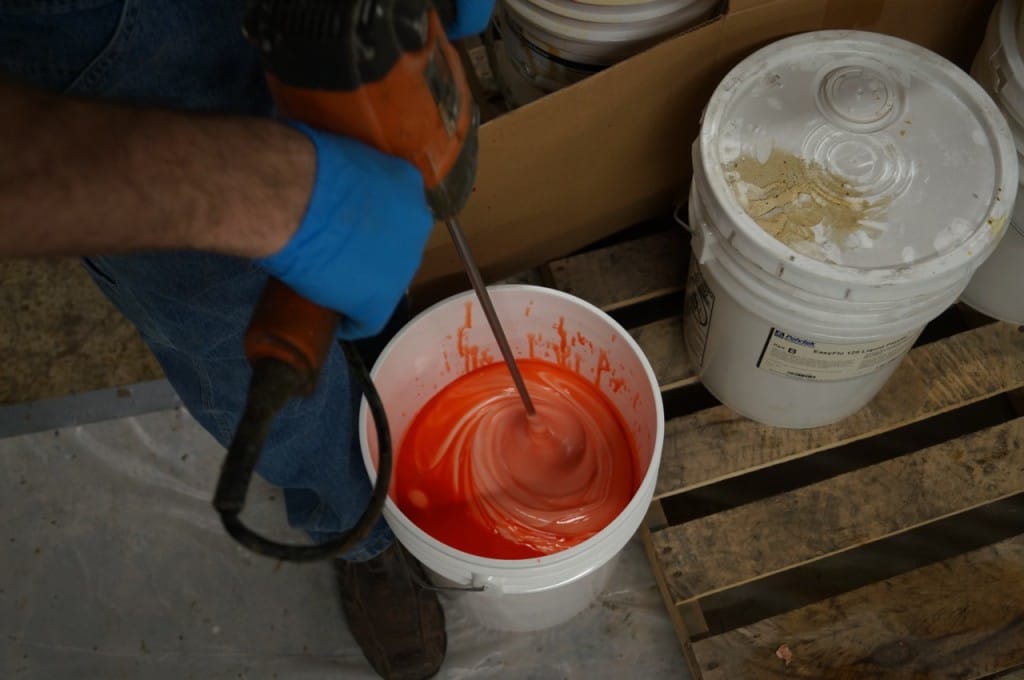

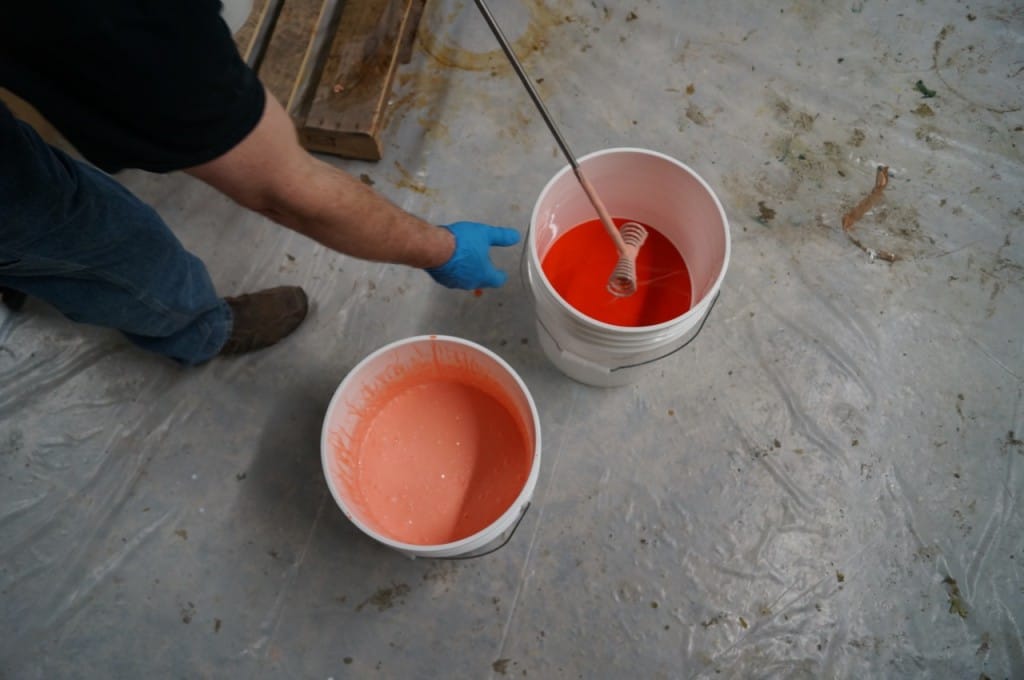
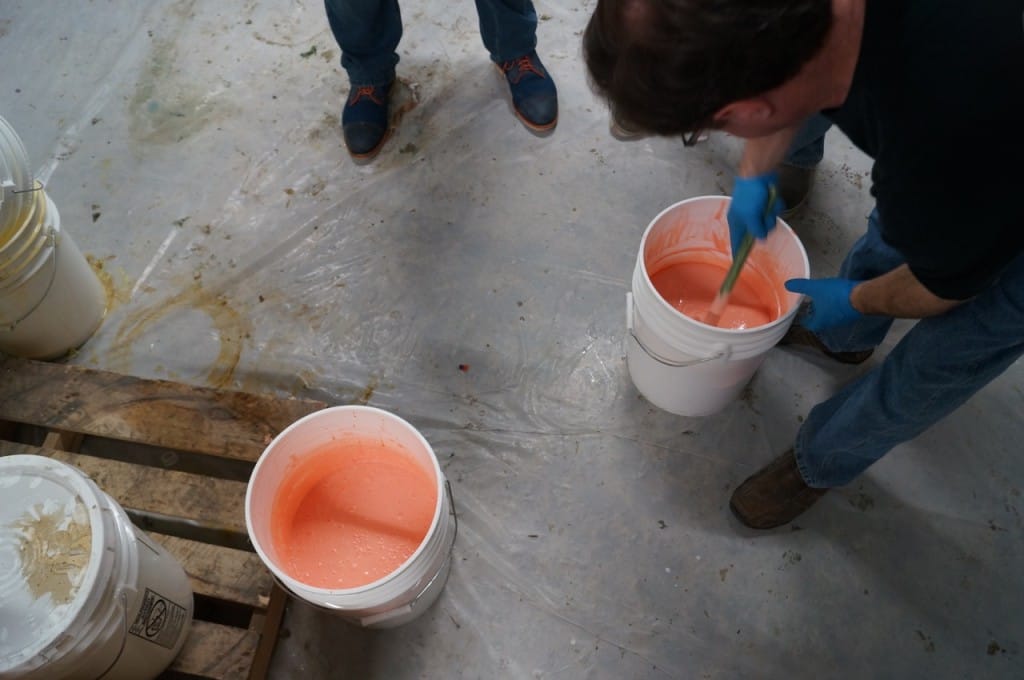
The batches are so mixed by hand with a Poly Paddle.
Notation: It is important to scrape the sides and lesser of the mixing container several times, as this is where unmixed fabric tends to cling.
The silicone is poured into the lowest betoken of the mold box and allowed to rise.
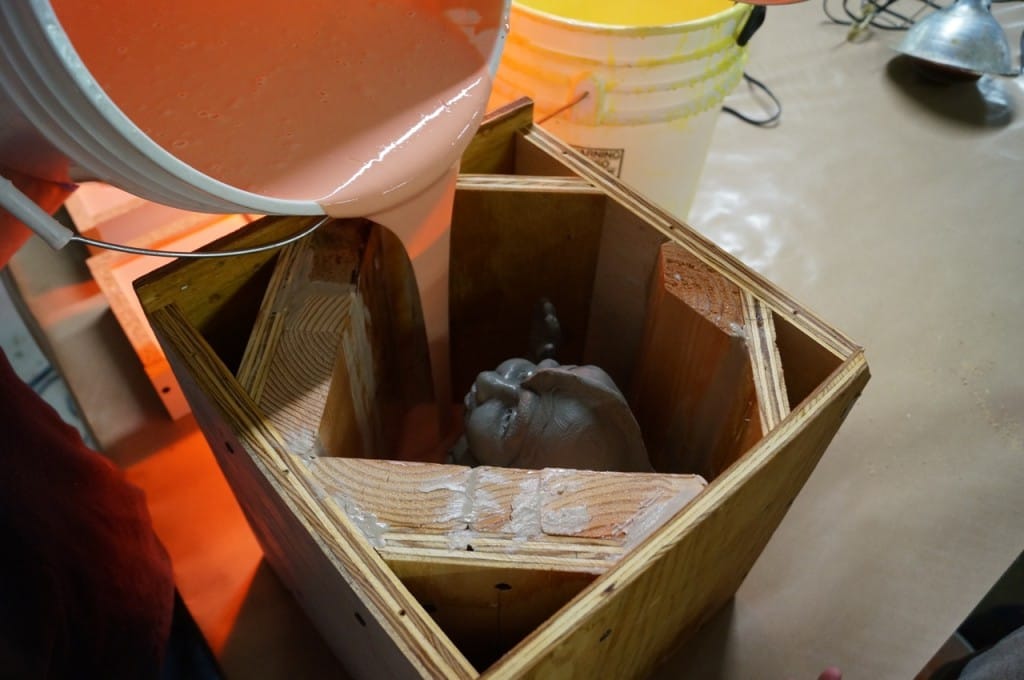
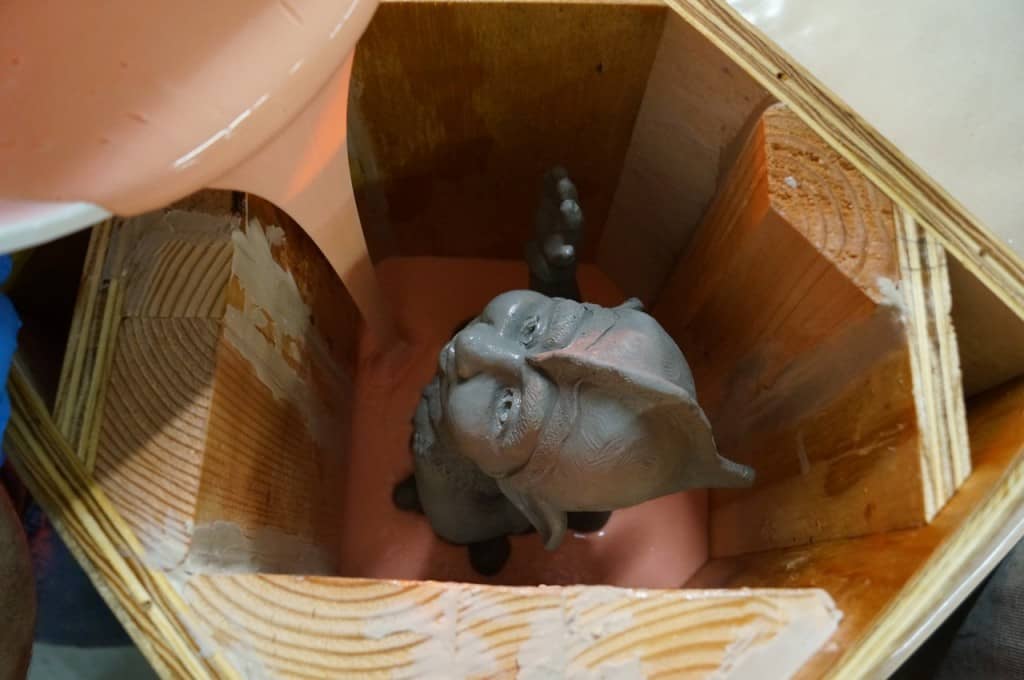
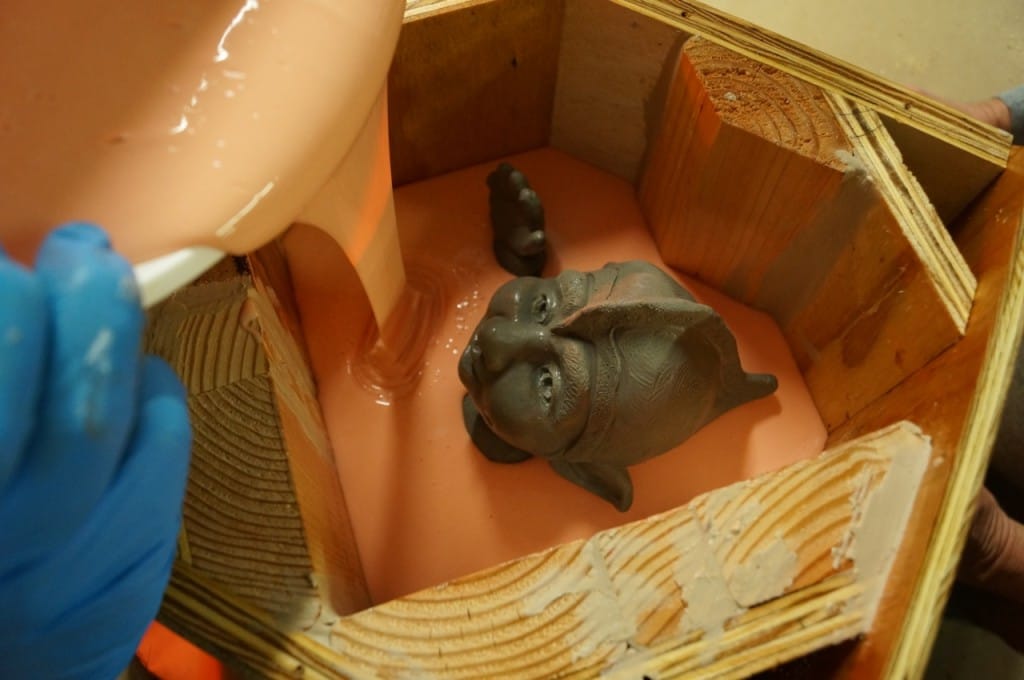
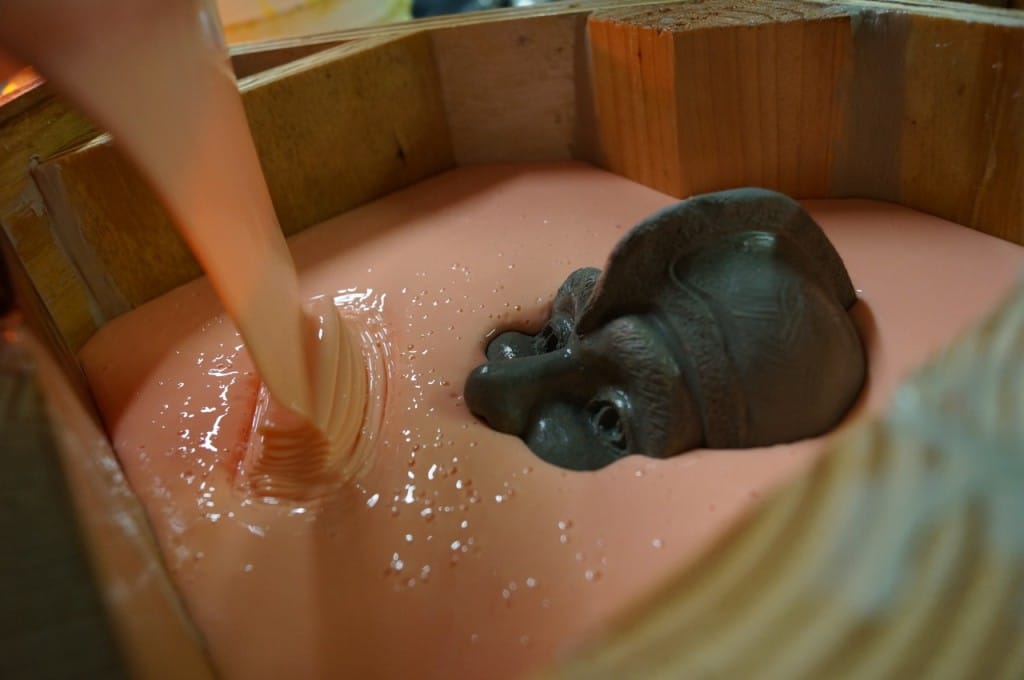
The rubber is poured until information technology reaches at least 1.0″ to a higher place the highest point on the sculpture.
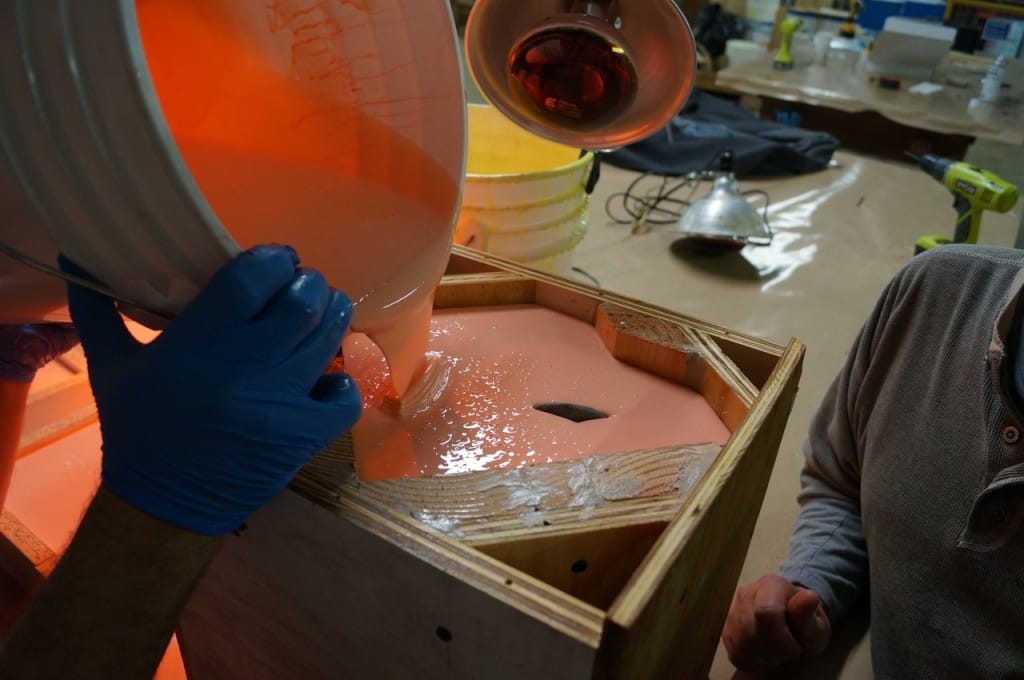
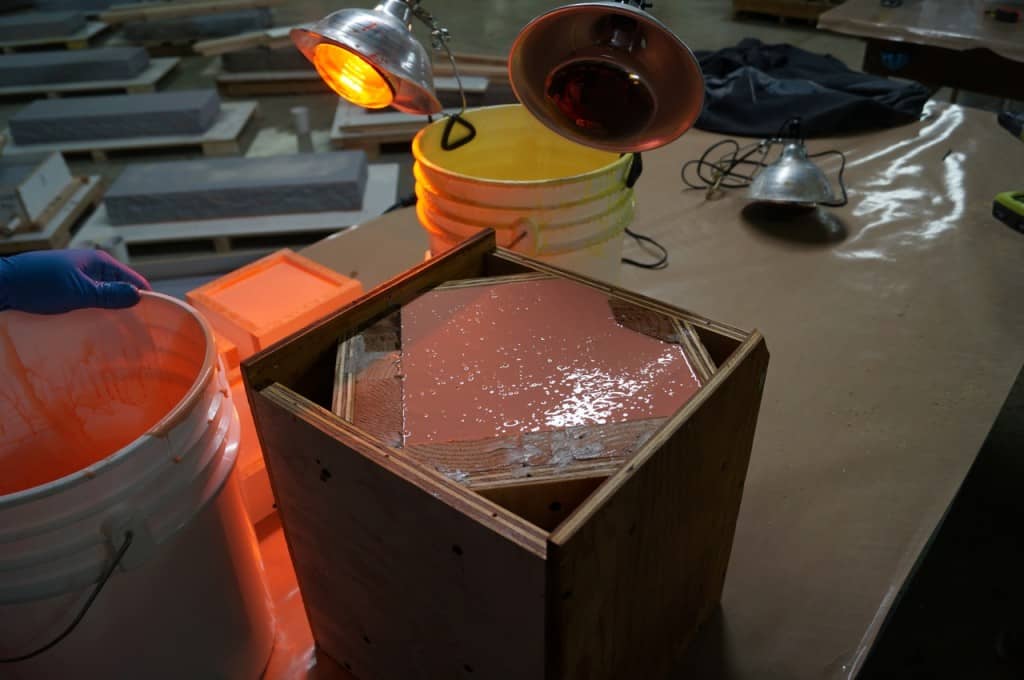
We allow the rubber to cure at room temperature for ~24 hours. Estrus lamps can help speed the cure.
NOTE: Demold times vary past product. Cheque product Technical Bulletins for this data.
Step 4: Demold
Earlier demolding, the locations of the mold box walls and cake-outs are marked with a pen. This is washed and then that the mold box tin can be put back together correctly for casting later.
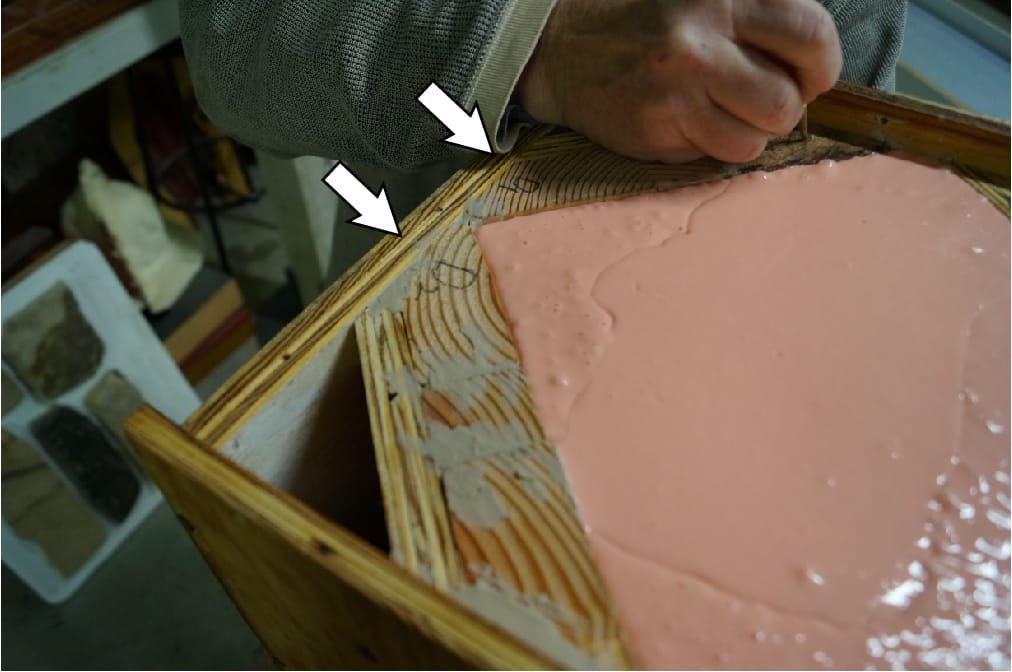
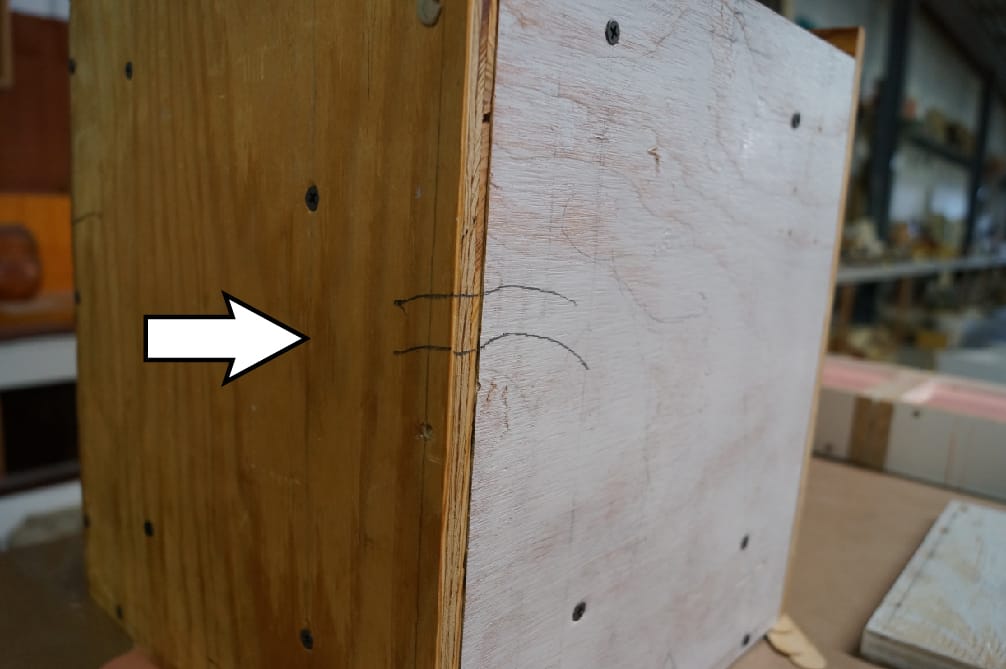
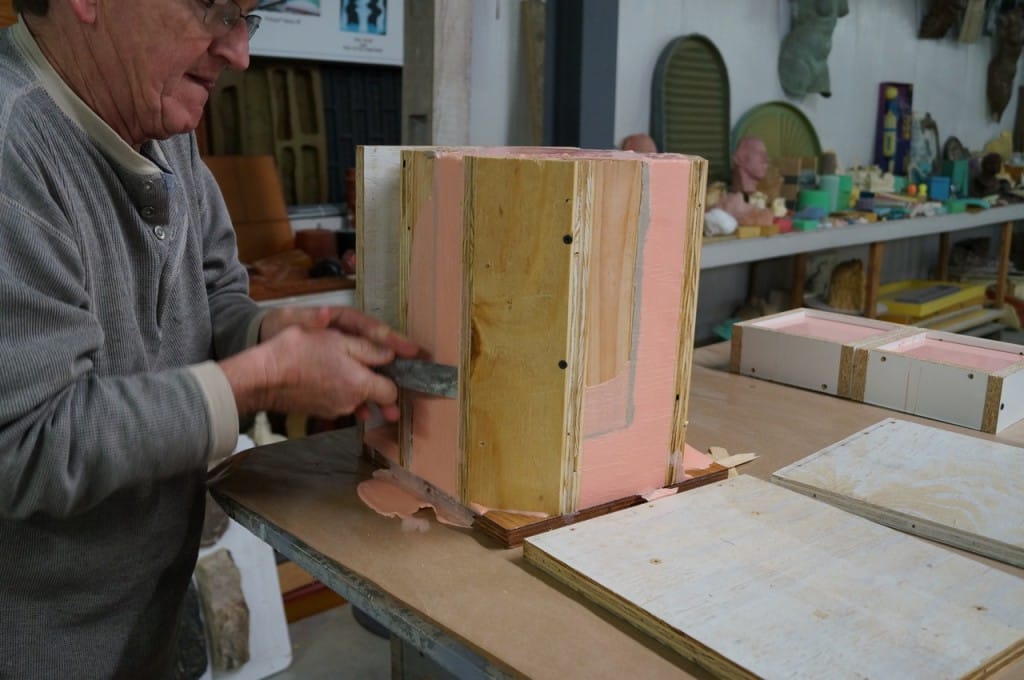
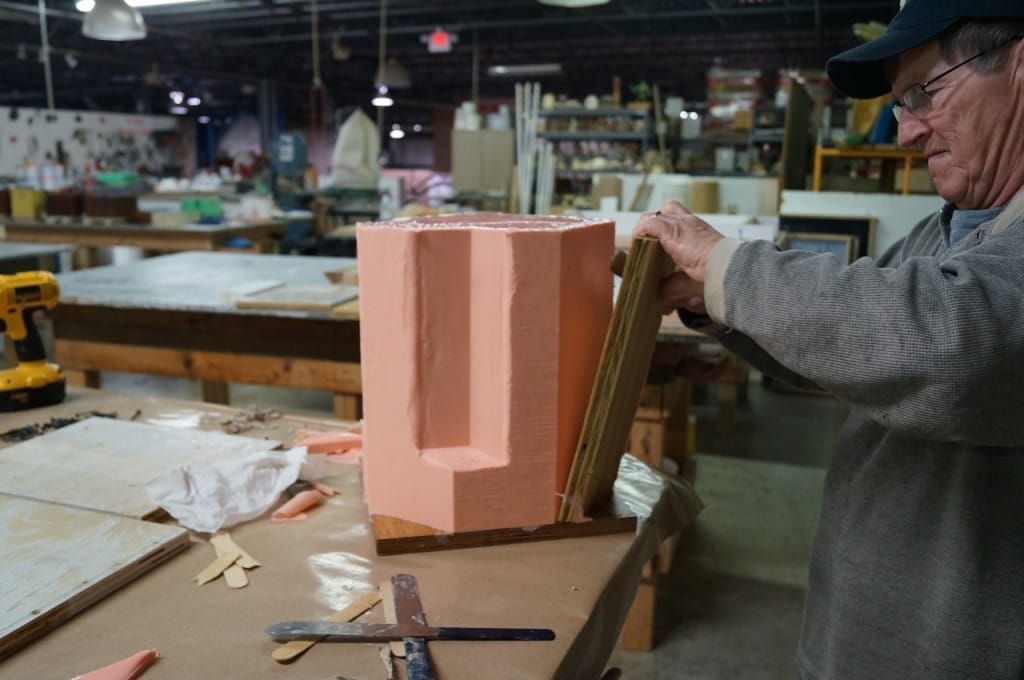
All edges of the mold are loosened from the baseboard with a putty pocketknife before the unabridged mold is removed.
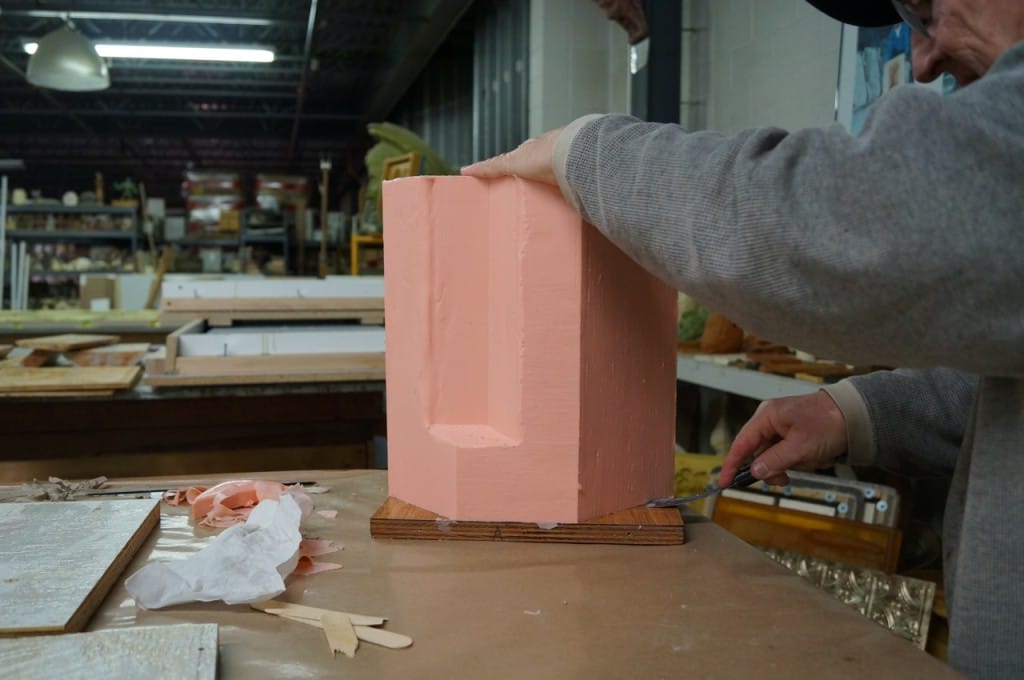
Upon removal of the mold from the baseboard, the sculpture splits in half, leaving the tiptop half in the mold.
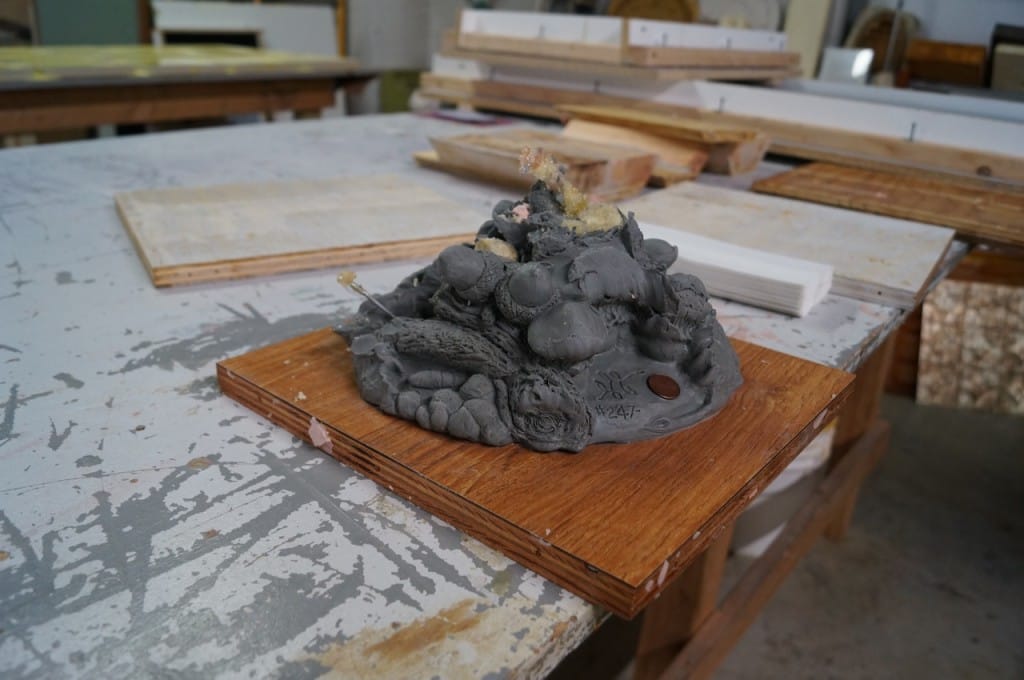
Step 5: Cut the Mold
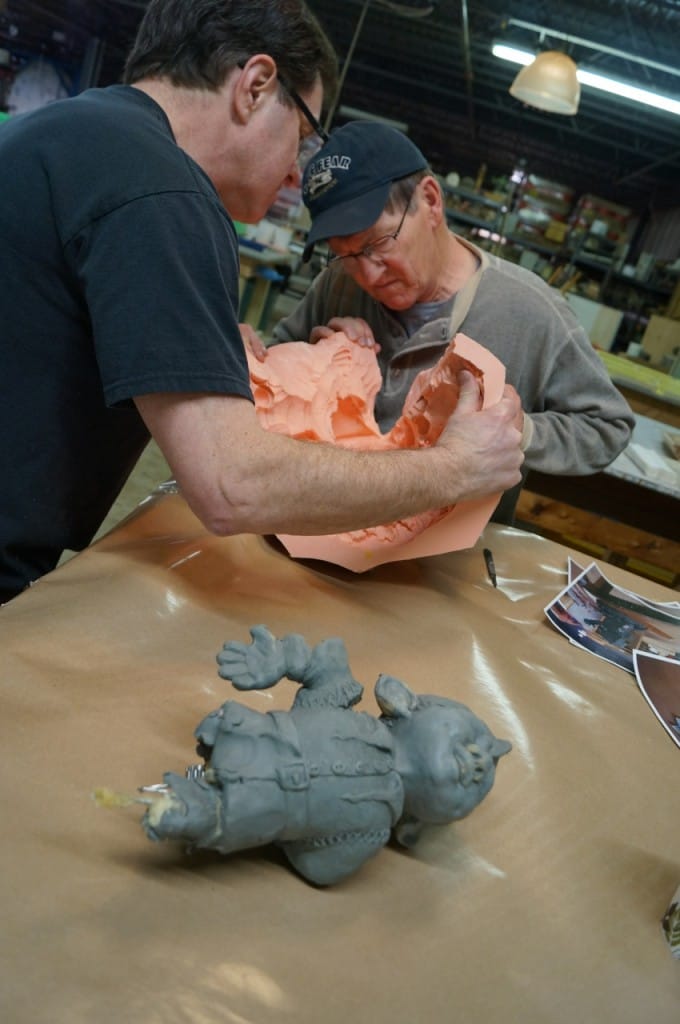
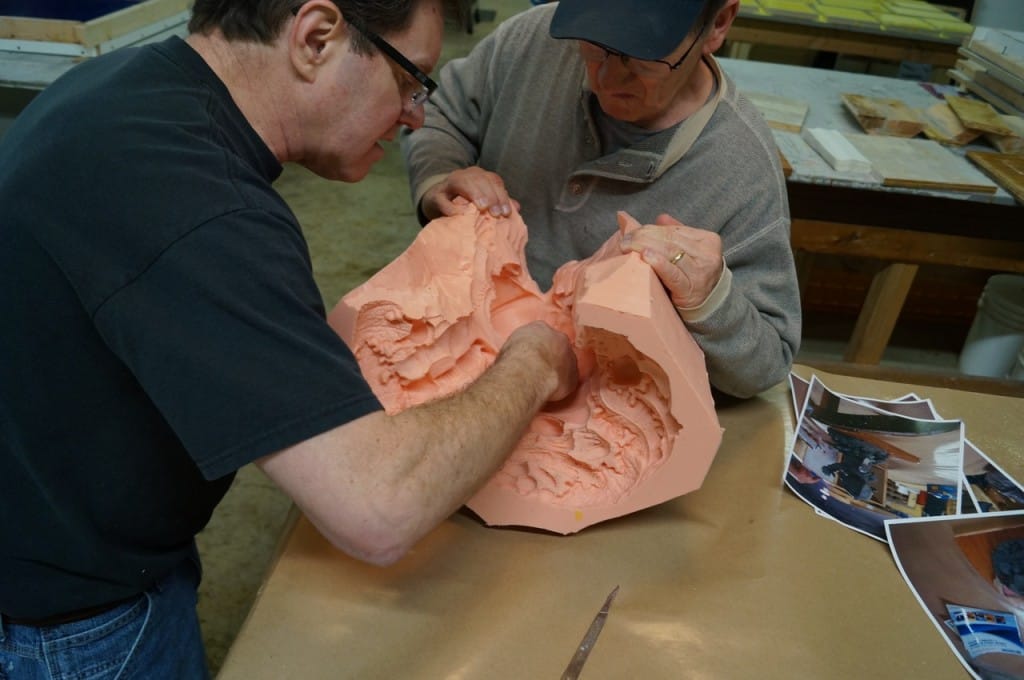
To remove the residual of the sculpture and subsequent castings, we set to make a cut on one side of the mold. Pictures of the sculpture are printed to determine a good location for the cut.
NOTE:If possible, it is best to cutting along a line that already exists on the sculpture or in an inconspicuous location (i.due east. avoid the face).
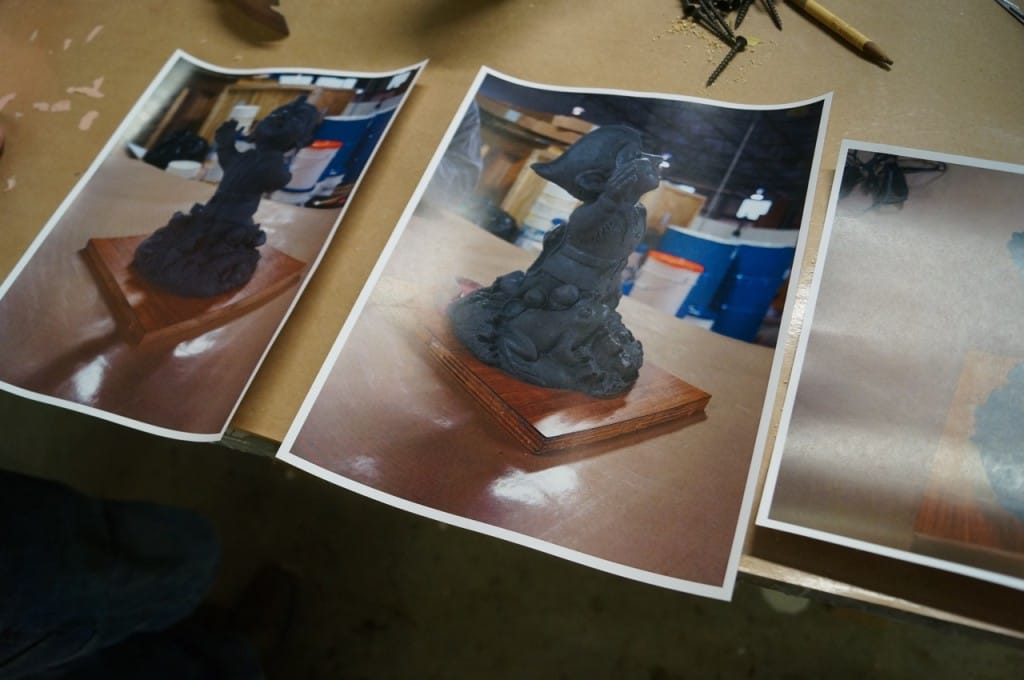
A scalpel is used to brand the cut.
NOTE:It is important to create an irregular cutting pattern (i.e., tongue and groove or zig-zag cutting) and then that the two sides marshal well for casting (for general data on cut rubber molds, visit this article).
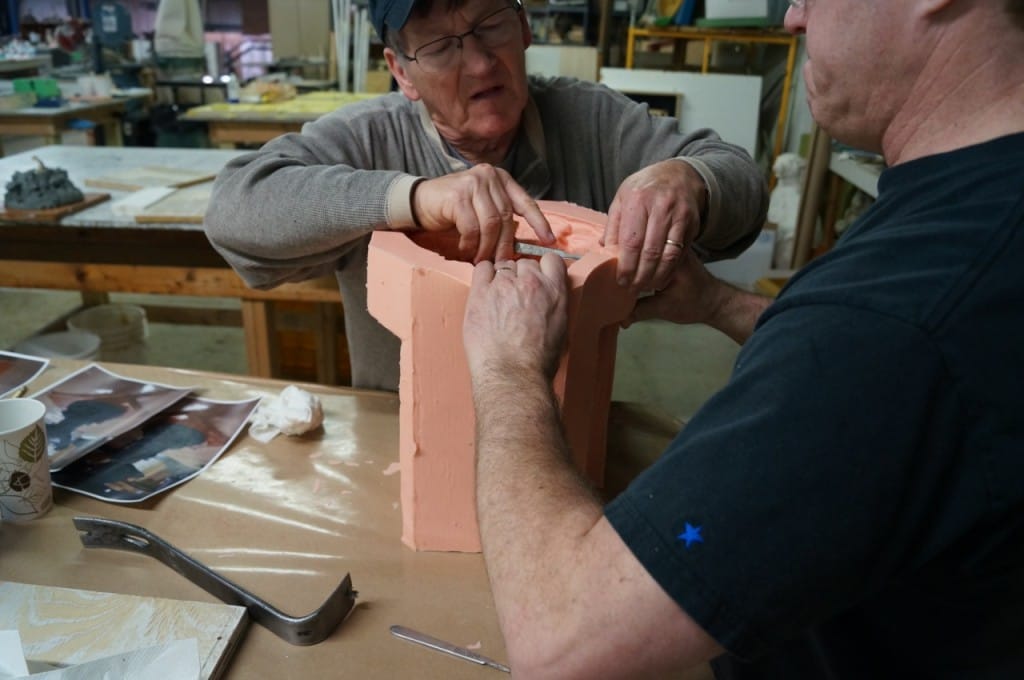
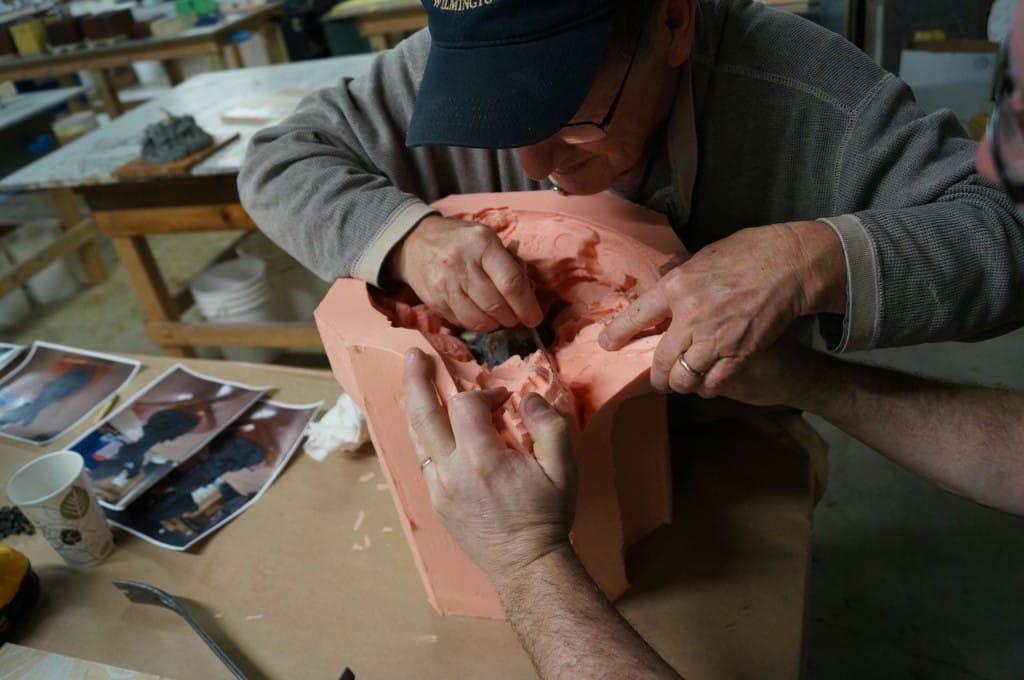
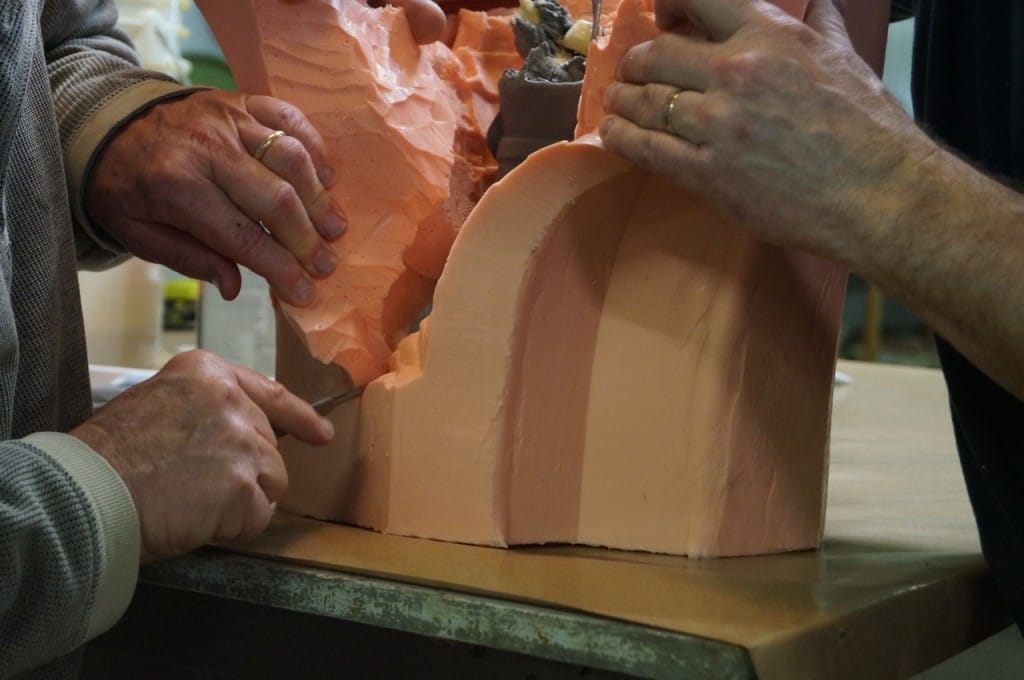
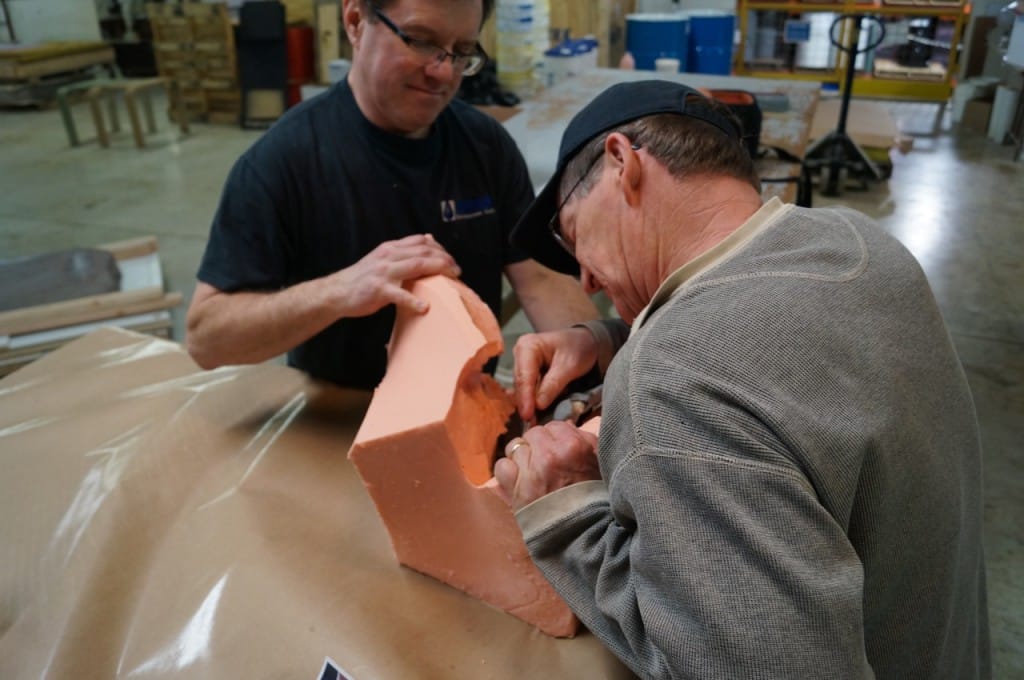
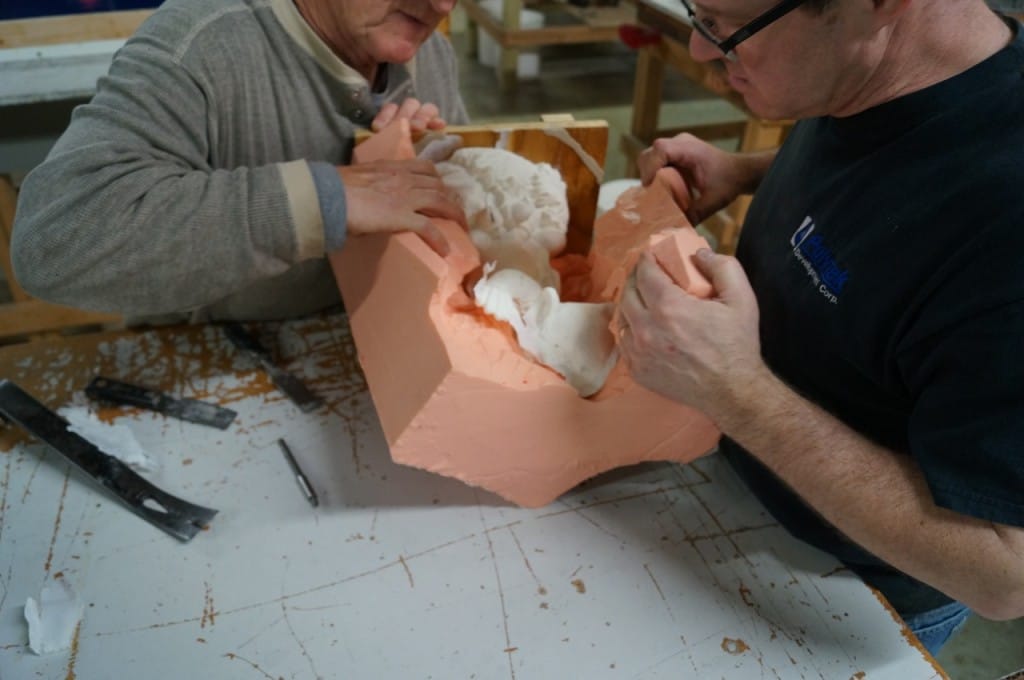
The remainder of the sculpture is removed from the mold and whatever clay left backside in the mold is cleaned out.
Step 6: Rotational Casting
The mold is placed dorsum into the mold box and then secured.
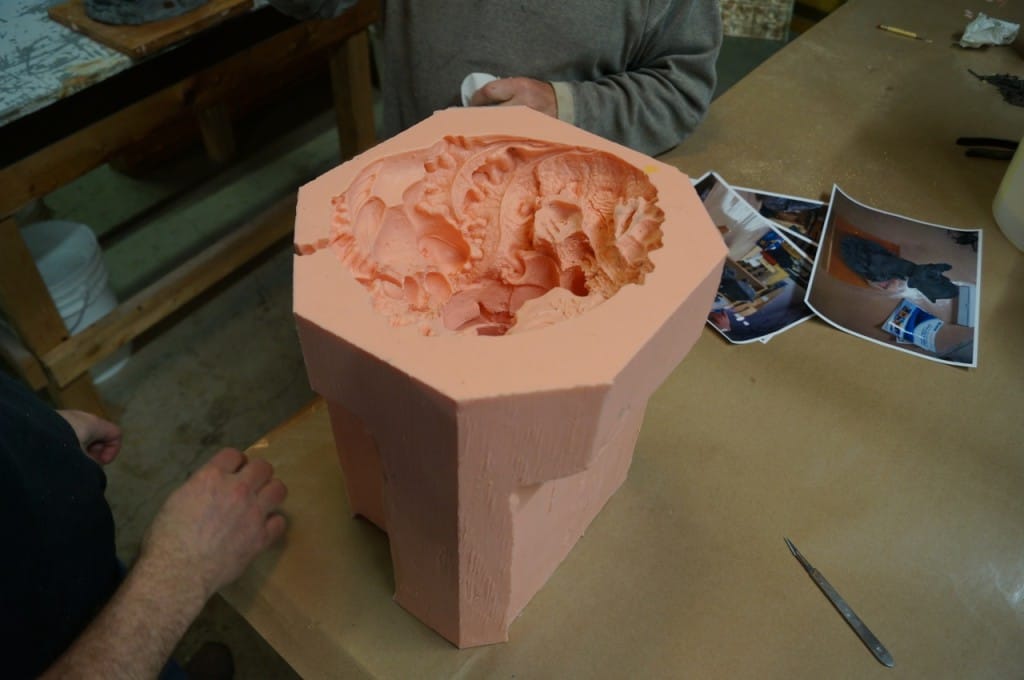
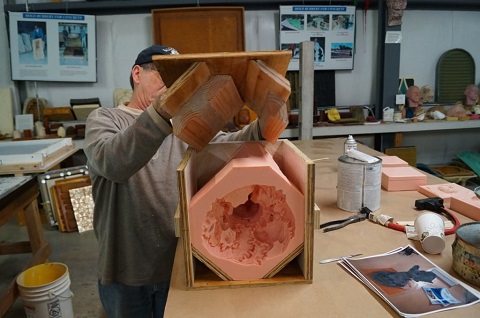
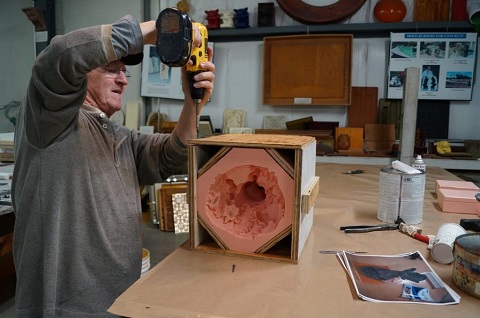
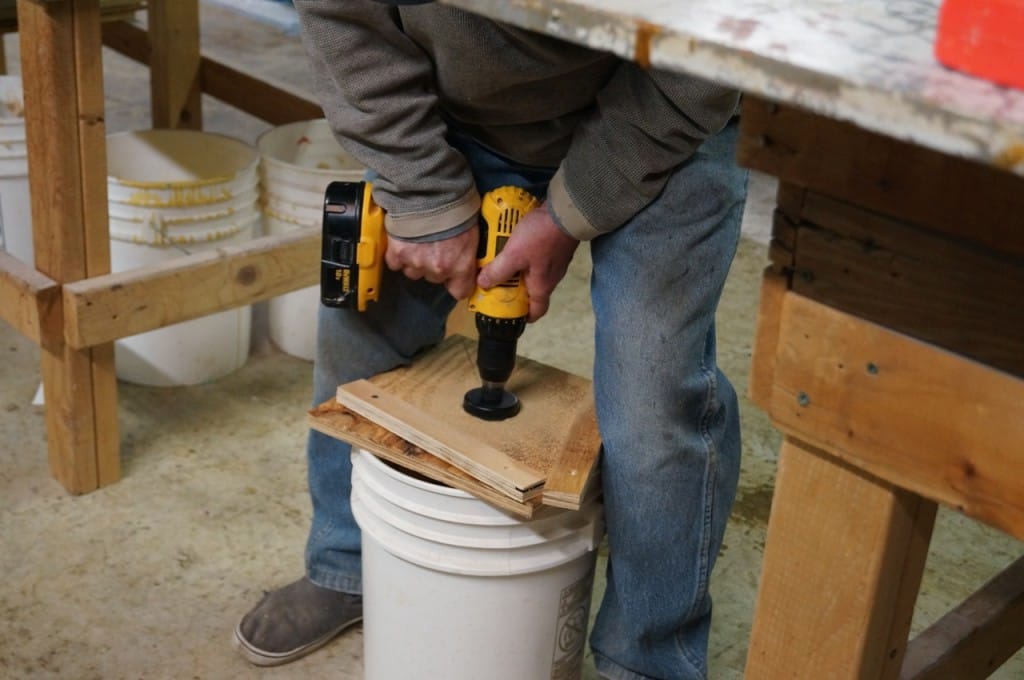
Because we programme to apply the rotational casting automobile, we create a mold box hat with a cascade hole. This pigsty is where the fast-setting resin is poured in one case the mold box is on the rotational casting auto.
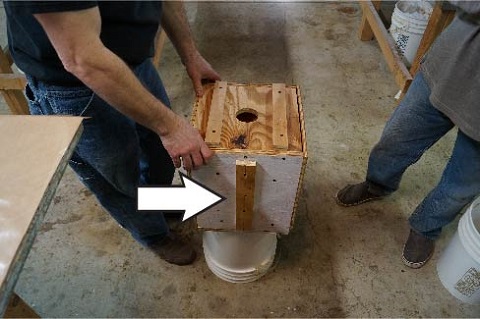
Wooden bars are added to the sides of the box in order to mount and attach it to the rotational casting machine.
A silicone plug will later be used to plug the pigsty when casting.
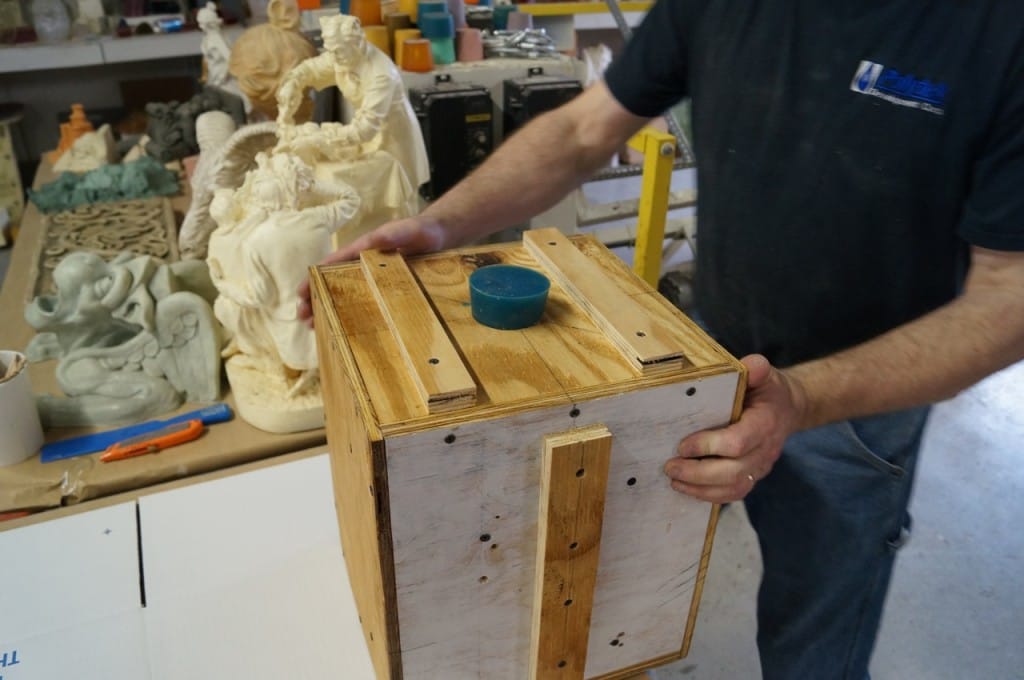
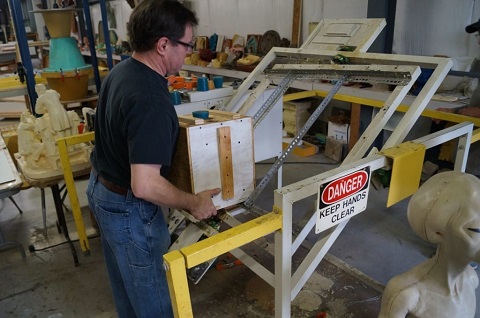
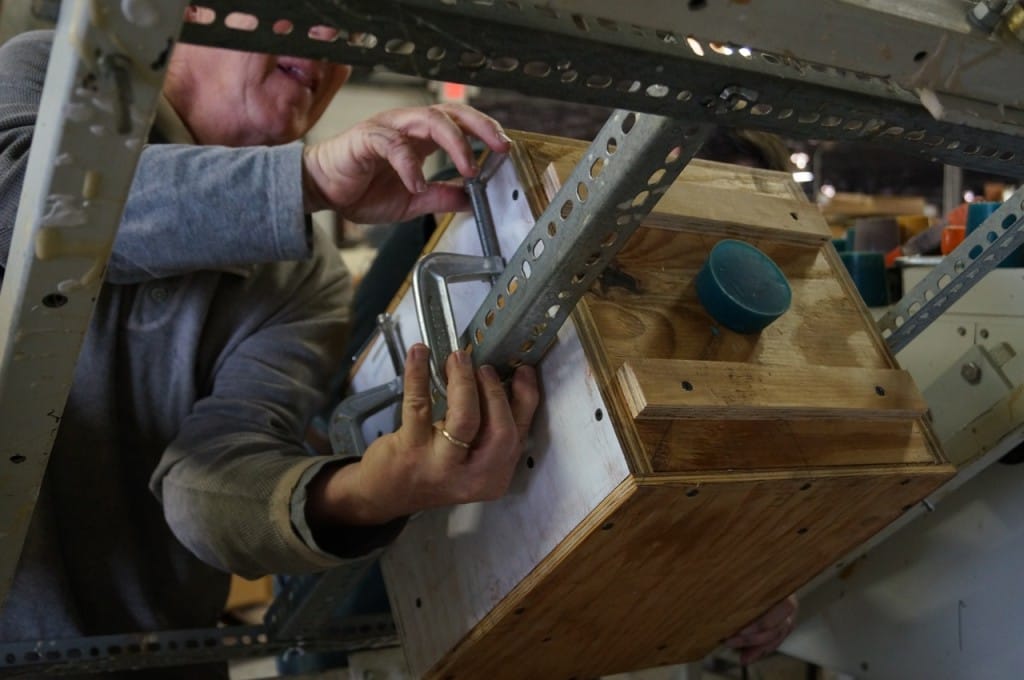
The mold box is loaded onto the rotational casting automobile and secured with C-Clamps.
EasyFlo 120 Liquid Plastic is the production that we nearly often recommend for rotational or slush casting. It is designed to gradually solidify over its working time, as opposed to "snap-fix" (similar the curing characteristics of EasyFlo 60, another product with the EasyFlo Series). This gradual thickening over the last thirty-45 seconds of the working time helps to provide an fifty-fifty coat.
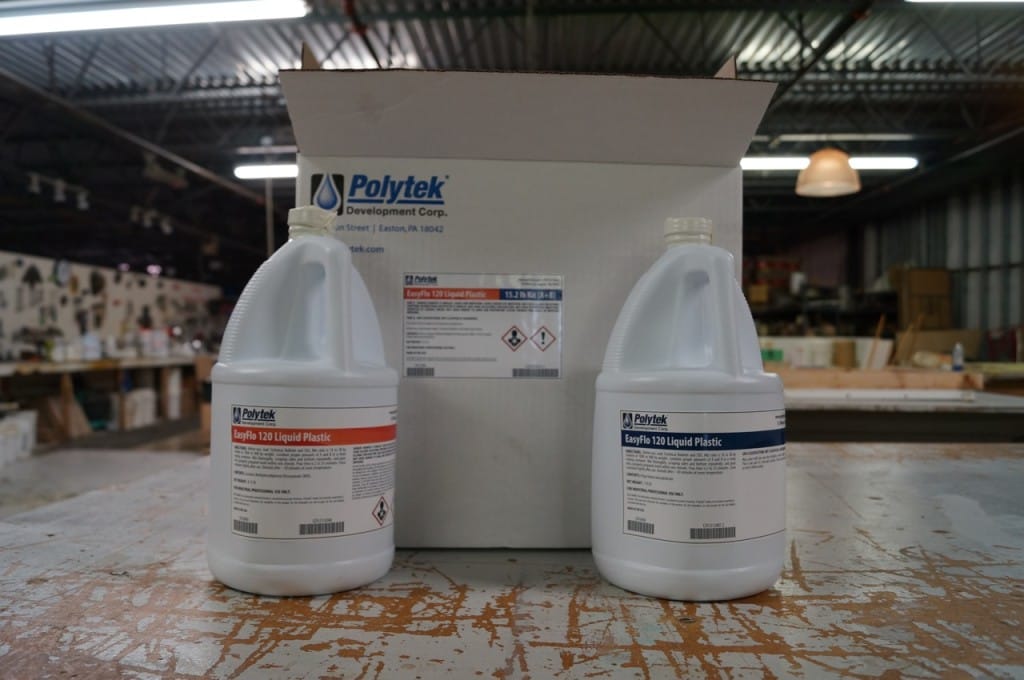
EasyFlo 120 Liquid Plastic: Specifications
Hardness: Shore D65
Mix Ratio: 1A:1B by volume, 100A:90B by weight
Pour Time: 2-2.five minutes
Mixed Viscosity: 120 cP
Demold Time: xv-30 minutes
Cured Colour: White
Specific Volume: 26.9 in³/lb
Approximately 2 lb of EasyFlo 120 is thoroughly mixed and poured into the mold.
NOTE:Ideally, this resin should be mixed and poured in under a minute.
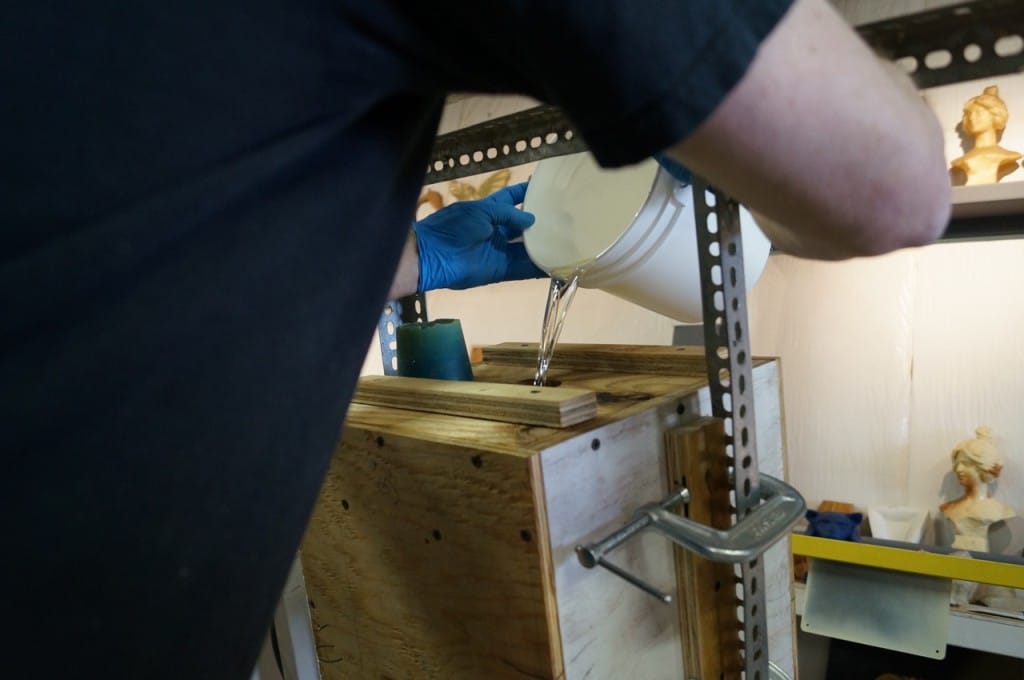
The pour hole is plugged with the silicone plug and then the car is turned on.
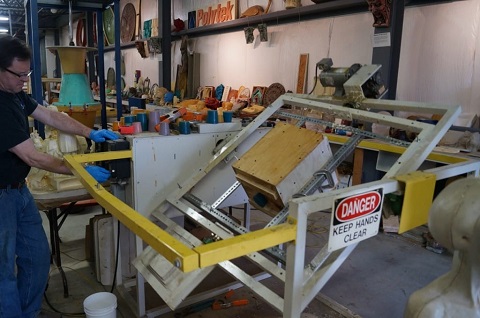
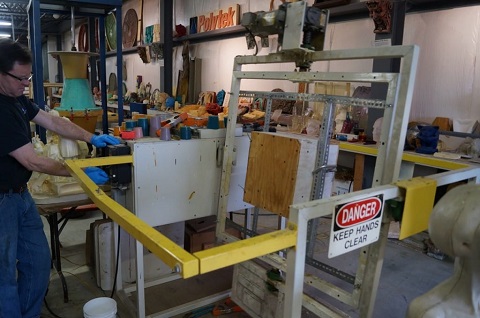
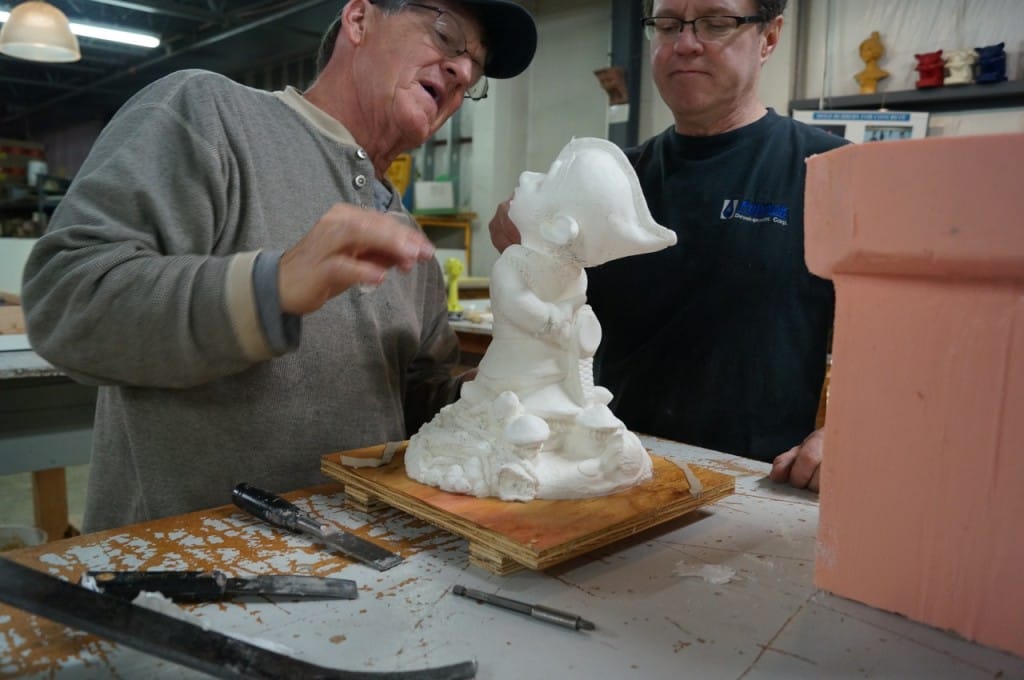
Subsequently ~30 minutes, the mold is removed from the rotational casting automobile so the casting is removed from the mold.
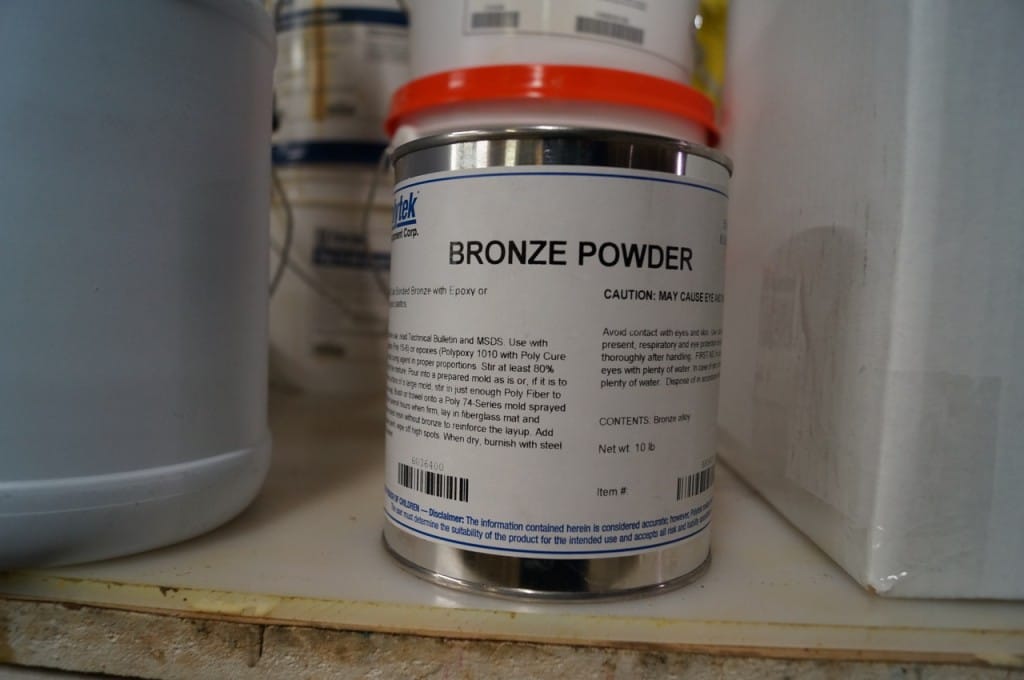
For the adjacent run, we mix EasyFlo 120 + Dark-brown PolyColor Dye + Bronze Powder to produce a cold cast statuary re-create.
Here are some photos of the cold cast bronze piece prior to burnishing with steel wool (steel wool is used to expose the bronze powder on the surface of the casting). Initially, castings will appear chocolate brown; you volition observe a small spot on his cheek that has been glassy.

Source: https://polytek.com/tutorial/mold-making-tutorial-silicone-mold-of-clay-sculpture/
Posted by: fosterager1944.blogspot.com
0 Response to "How To Clean Monster Clay Out Of A Deep Mold"
Post a Comment